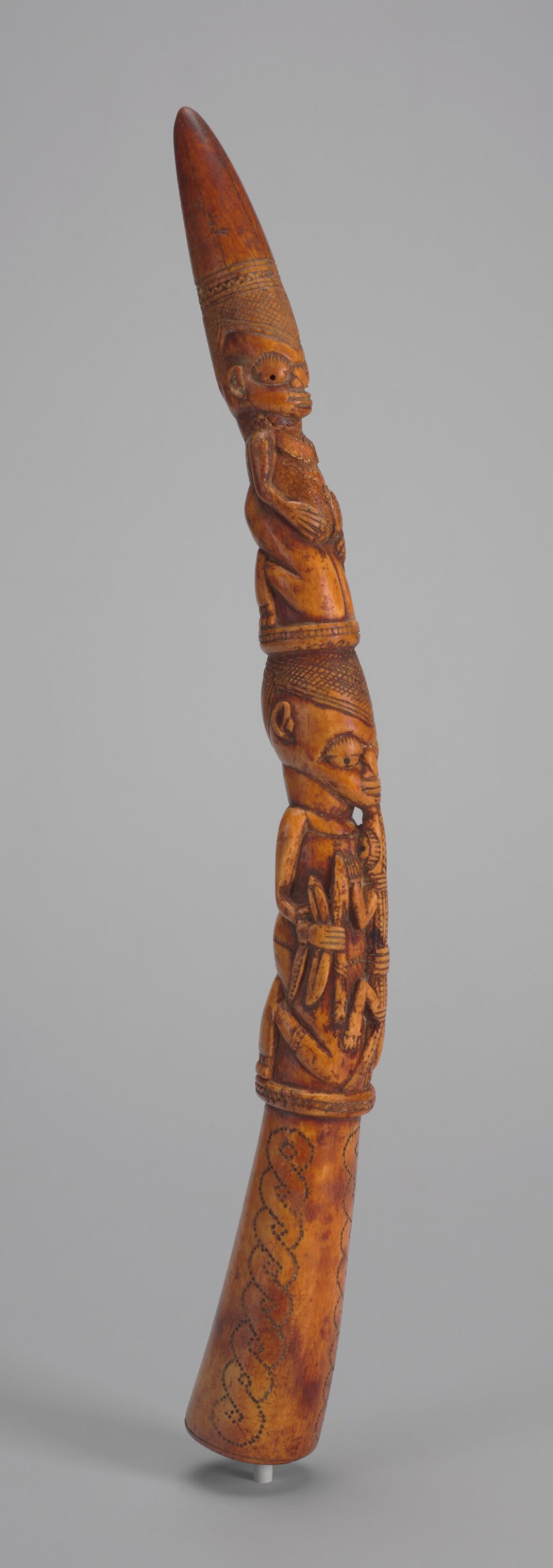
The Iroke Ifá brings sound and sculpture together in Yoruba divination. Struck against a divination tray, the slender implement calls the attention of Orunmila, the divinity associated with wisdom, before the diviner begins a consultation.
Carvers have made these tappers in wood and ivory, often incorporating a kneeling woman into their elongated form. Their purpose connects the carved figure to spoken invocations and the specialist knowledge of the babalawo, or diviner. The object is handled and sounded as part of a practice built around interpretation and recitation.
The University of Michigan Museum of Art explains that the tapper also adds rhythm to the babalawo’s chants. Its early twentieth-century example, made from ivory and metal, has a slightly curved body. A woman kneels in its middle, holding her breasts, while the lower end narrows towards a rounded point.
The museum identifies the kneeling posture, ikunle, as a gesture of respect. It also connects the conical form to the ibori, a shrine to the inner head, and the ade, an oba’s crown. In this interpretation, the shape refers to Yoruba understandings of the inner head and personal destiny.
A mid-nineteenth-century tapper at the North Carolina Museum of Art gives the kneeling woman an elaborate conical coiffure. The museum reads her posture as supplication and reverence, and her nudity as a reference to purity and women’s capacity to hold and give life. Its account describes a diviner striking the tip against the tray while reciting phrases that seek the divinity’s attention.
These figures were not restricted to naturalistic proportions. Brooklyn Museum’s ivory tapper has an exaggerated human form, which the museum relates to the shape of the material and the implement’s function. Its catalogue suggests an eighteenth-century date and Owo, in present-day Ondo State, as a possible place of manufacture; neither identification is certain.
The featured ivory example belongs to the Art Institute of Chicago. Attributed to an unidentified Yoruba artist, it is catalogued as seventeenth or eighteenth century. The work entered the collection as a gift of Richard Faletti from the Faletti Family Collection.
Wooden examples show another part of this carving tradition. The Metropolitan Museum of Art holds a Yoruba tapper made from wood and camwood bark, dated to the nineteenth or twentieth century. Colgate University’s collection includes a wooden example with a small kneeling woman near its lower end, alongside another decorated with an animal eating a fish.
The tapper has a different role from the àgéré Ifá, the vessel that holds sacred palm nuts, and the opon Ifá, the divination tray. Each belongs to the material setting of consultation, but the objects are not interchangeable.
Ifá itself extends well beyond these implements. UNESCO describes a system practised among Yoruba communities and in the African diaspora in the Americas and Caribbean. Its literary corpus comprises 256 odu, subdivided into verses known as ese. UNESCO notes that the precise number of verses is unknown because the body of texts continues to grow. The Ifá divination system entered its Representative List of the Intangible Cultural Heritage of Humanity in 2008.
Image: Art Institute of Chicago, 2000.316, Gift of Richard Faletti, the Faletti Family Collection. Photograph supplied through Wikimedia Commons, CC0. Historic ivory object.