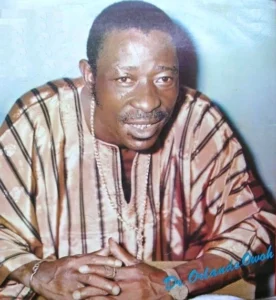
Imesi-Ile in Osun State is mourning the death of its Owa-Ooye, Oba Enoch Ademola Akinyemi, Oyoyo II, whose 21-year reign was closely associated with community peace, development and the preservation of the town’s cultural heritage.
The first-class monarch died on Friday, 16 October 2026, aged 85. He would have celebrated his 86th birthday next month, according to the Imesi-Ile Progressive Association.
His transition was formally announced by the Obaala of Imesi-Ile and Chairman of the Owa-Ooye-in-Council, High Chief Olatunde Aluko, on behalf of the royal council and the community.
The council described Oba Akinyemi as “a father to all, a symbol of peace, unity and development” whose reign brought honour and progress to Imesi-Ile.
Traditional rites began on Friday in accordance with the customs of the town. The royal family and the Owa-Ooye-in-Council are expected to announce burial arrangements and further details in due course.
A community pauses to honour its monarch
The Imesi-Ile Progressive Association, which represents indigenes of the town, has suspended its major public outings until further notice. The decision reflects both respect for the late monarch and observance of the traditional period following the transition of an Owa-Ooye.
In a statement signed by its President, Samuel Agbeluyi, and General Secretary, Sola Oluwadare, the association said the late king maintained cordial relations with successive governments and supported projects that strengthened Imesi-Ile.
It also credited him with helping to preserve the town’s cultural identity and historical heritage. Of particular importance was his support for the Kiriji War celebration, which has drawn wider attention to Imesi-Ile and its place in Yoruba history.
The association said the most recent Kiriji celebration was one of the monarch’s final major public appearances. His presence at that gathering now carries added meaning for a community whose public history and royal institution are closely connected.
For many Yoruba towns, the passing of a monarch is more than the loss of an individual leader. It marks a transition within an institution that holds memories of migration, settlement, kinship, festivals, customary authority and the relationship between the palace and the wider community.
The Owa-Ooye stool and its Ile-Ife roots
The Owa-Ooye is the paramount traditional ruler of Imesi-Ile. The community’s official historical account describes the holder of the title as a beaded-crown monarch whose royal line is traced directly to Ile-Ife, the spiritual cradle of the Yoruba people.
That account identifies Oba Akinyemi as the 44th ruler in the succession history associated with the Owa-Ooye stool. It explains that the early royal line began with princes linked to ancient Ile-Ife and that Owalosin became the first Owa-Ooye to rule from what developed into present-day Imesi-Ile.
The traditional structure surrounding the throne includes the Owa-Ooye-in-Council and the six principal kingmakers known as the Iwarefa or Iwareke. The Obaala heads that body and serves as prime minister within the royal council.
These institutions are part of the cultural framework through which the community manages palace affairs and royal transitions. At this stage, the council has announced only the monarch’s death and the commencement of traditional rites. No succession timetable or candidate has been announced, and speculation would be premature.
A reign remembered for stability and heritage
Oba Akinyemi was an engineer and was widely known in the community as Baba Daadaa. He ascended the throne more than two decades ago and reigned through periods of political and social change in Osun State and across Nigeria.
The Progressive Association said his leadership created an atmosphere that supported communal harmony, collective advancement and a stronger relationship between Imesi-Ile and neighbouring communities.
Its tribute placed cultural preservation alongside physical development as a central part of his legacy. That assessment is significant for a town often identified as Ilu Kiriji and connected in public memory with the Kiriji War, one of the defining conflicts of nineteenth-century Yorubaland.
By supporting the commemoration of that history, the monarch helped keep local memory within public conversation. Such celebrations can connect younger generations and members of the diaspora with the places, institutions and stories from which their families emerged.
The mourning period will now be led by the royal family, the chiefs and the wider Imesi-Ile community. Indigenes, friends of the town and cultural organisations have been asked to respect official palace announcements while traditional observances continue.
Podium News extends condolences to the royal family, the Owa-Ooye-in-Council and the people of Imesi-Ile. Readers with verified photographs or documented memories of Oba Akinyemi’s reign may contact the newsroom to help preserve an accurate public record of his service and cultural legacy.