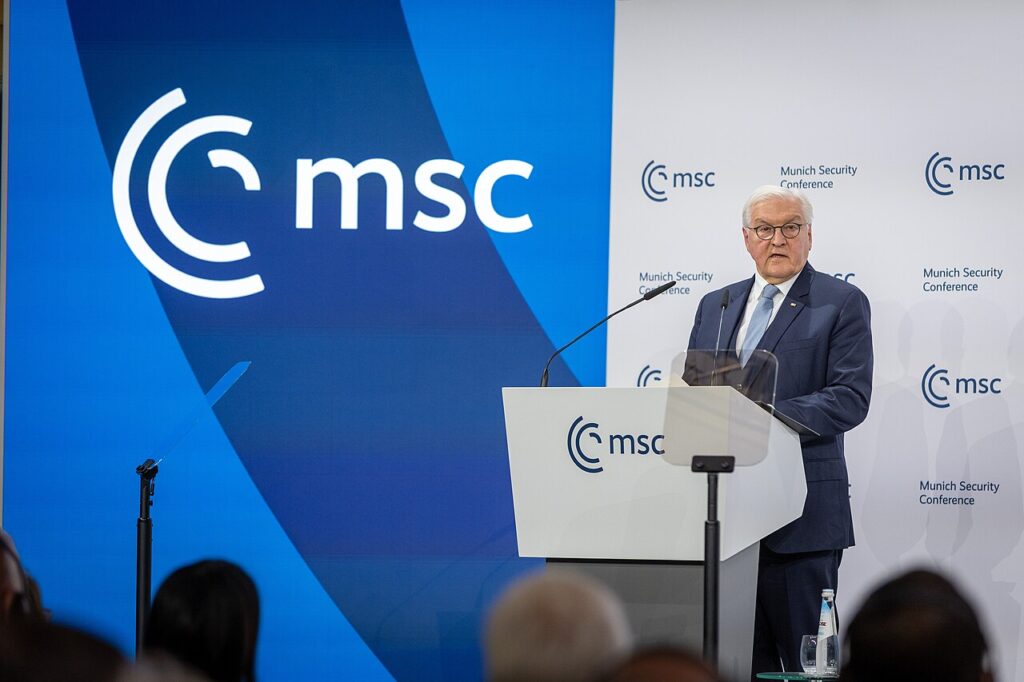
German President Frank-Walter Steinmeier has warned that political extremism, online disinformation and declining trust in public institutions are placing the country’s democratic unity under severe strain, 36 years after reunification.
Speaking at Germany’s national Unity Day ceremony in Bremen on Saturday, 3 October, Steinmeier said the country could not treat the freedoms secured through reunification as permanent or self-sustaining. He invoked the bitter polarisation that preceded the collapse of the Weimar Republic, while stopping short of declaring that modern Germany had reached the same point.
“Whether Berlin is becoming more like the Weimar Republic is a question that has yet to be answered,” the president said.
The warning came after a series of state elections transformed Germany’s political landscape. The Alternative for Germany, or AfD, won the largest share of the vote in Saxony-Anhalt and Mecklenburg-Western Pomerania, while The Left finished first in Berlin. Chancellor Friedrich Merz’s Christian Democrats suffered historic setbacks in the eastern states.
Steinmeier did not name any political party in his address. He instead condemned what he called the intolerable demagoguery of extremist forces, arguing that attacks on democratic institutions, sophisticated manipulation online and the hardening of political camps could weaken national cohesion.
Germany’s presidency is largely ceremonial, but the office carries considerable moral authority. Steinmeier, a Social Democrat and former foreign minister, used that platform to urge the federal government to respond with competent, steady policy rather than slogans or short-term political calculation.
A national celebration shadowed by distrust
Unity Day commemorates the formal reunification of East and West Germany on 3 October 1990. This year’s ceremony was held in Bremen under the theme “Many Strengths, One Country”, with more than 400,000 visitors expected across a weekend of public events.
Steinmeier described reunification as the healing of a deep national wound, but acknowledged that many Germans had not seen all their expectations fulfilled. Economic and social differences between the former eastern and western regions remain politically sensitive, while distrust of the established political system has grown on both sides of the old divide.
He said as many as one-third of voters were signalling through their choices that they were turning away from core constitutional rights. The president linked that estrangement to a mix of falling living standards, economic anxiety, hostile rhetoric and disinformation spread by both foreign and domestic actors.
Germany remains Europe’s largest economy and its leading industrial power, but its manufacturing base is under pressure from stronger competition from China, high energy costs and weak growth. The loss of cheap Russian oil and gas after Moscow’s invasion of Ukraine added to the strain, while the costs of housing and everyday life have become potent political issues.
Those pressures have helped the AfD consolidate support. The party rejects the far-right label and says mainstream opponents use it to discredit views held by millions of Germans. Several regional intelligence authorities, however, have classified parts of the party as extremist, intensifying debate over whether and how democratic institutions should engage with it.
Why the Weimar comparison carries weight
The Weimar Republic was Germany’s democratic system between the end of the First World War and Adolf Hitler’s rise to power in 1933. It was weakened by economic crisis, political violence, institutional distrust and the normalisation of anti-democratic movements.
Historical comparisons require care because today’s Germany has a strong constitution, independent courts, established democratic parties and deep ties to the European Union and NATO. Steinmeier’s point was not that history is repeating itself exactly, but that democracies can be eroded when citizens lose confidence, lies overwhelm shared facts and opponents begin treating one another as enemies.
That concern was echoed elsewhere at the Bremen ceremony. Andreas Bovenschulte, Bremen’s mayor and the current president of the Bundesrat, said democracy requires disagreement but that a political opponent is not an enemy. Church leaders also urged Germans to resist exclusion, antisemitism and social polarisation.
The anniversary therefore carried two messages. It celebrated the peaceful revolution that ended communist rule in East Germany, while warning that the democratic achievement born from that movement still requires active protection.
A test beyond Germany
The debate matters well beyond German borders. Berlin is central to Europe’s economic policy, support for Ukraine, migration decisions and the continent’s response to strategic competition with Russia and China. A weakened or paralysed German government would have consequences across the European Union and for partners in Africa that depend on German trade, investment and development cooperation.
Steinmeier’s appeal placed responsibility on government and citizens alike. Public institutions must deliver reliable services, credible economic policy and fair opportunities. Political leaders must also defend facts and democratic norms without dismissing the grievances of voters who feel ignored.
For citizens, the challenge is to resist manipulation, demand accountability and preserve the distinction between fierce democratic disagreement and hostility to democracy itself.
Germany’s reunification showed that peaceful civic action could overcome a seemingly permanent division. Thirty-six years later, its president is asking the country to apply the same seriousness to a new danger: the slow fragmentation of a democracy from within.
What do you think? Share your view on how democratic societies should confront disinformation and political extremism without silencing legitimate dissent.