Gelede combines carved headdresses, Yoruba song and dance in a performance tradition that honours women. Communities across Nigeria, Benin and Togo use it to recognise women’s place in community life.
Practised among Yoruba-Nago communities, it pays tribute to Iyà Nlà, the primordial mother, and recognises women’s contribution to social organisation. UNESCO proclaimed its oral heritage in 2001 and inscribed it on the Representative List of the Intangible Cultural Heritage of Humanity in 2008.
The celebrations are associated with the period after harvest, important communal occasions and responses to crises such as drought or epidemics. Their Yoruba-language chants recount histories and myths, while poetry, humour and satirical imagery provide ways to address conduct within the community.
UNESCO’s account identifies pressures on the tradition, including the erosion of specialist knowledge and the risk that tourism reduces an intricate religious and social practice to a performance detached from its setting. The designation covers an oral and performing heritage rather than a single collection of carved objects.
The headdresses nevertheless offer a detailed record of the artists who give the performances their visual form. The Metropolitan Museum of Art’s account of a twentieth-century example from Benin explains that a carved head is worn at an angle above the dancer’s own head, supporting a sculptural arrangement drawn from Yoruba life.
That example, given to the museum by Paul and Ruth W. Tishman in 1990, has two snakes curving around a four-legged animal, probably a porcupine. Holes carved into the animal’s body were intended to receive quills. The museum interprets the scene as an illustration of relationships and hierarchy in the natural world.
In its discussion of the festival, the Met describes elder women as “our mothers”, people whose spiritual powers are understood within the tradition as capable of benefiting or harming a community. Sculpture, dance, music and song honour them and seek their goodwill. The animal scene belongs to that religious and social vocabulary.
Other collection records show the geographical range and individual makers behind Gelede sculpture. A nineteenth- or twentieth-century headdress attributed to a Yewa-Yoruba artist comes from the Meko region of Nigeria. Made from wood and pigment, with metal staples, it entered the Michael C. Rockefeller Memorial Collection.
A further Met headdress is associated with Falola Edun and Fagbite Asamu of Idahin. The record names both artists and identifies the work with Ketu-Yoruba culture. Such attributions preserve the names of particular makers alongside the broader community identity under which museum objects are often catalogued.
Brooklyn Museum’s interpretation of its Gelede masks places male dancers within the festivals’ recognition of women, living and dead. It identifies both senior women and female ancestors among the Great Mothers being honoured. The dancer and the sculptor therefore contribute to a performance whose central subjects extend beyond those physically carrying the masks.
One Brooklyn example, dated to the late nineteenth or early twentieth century and made in Benin, incorporates a curled snake into an elaborate coiffure. Its collection record notes pierced eyes and nostrils, combining the details of a human face with an animal motif.
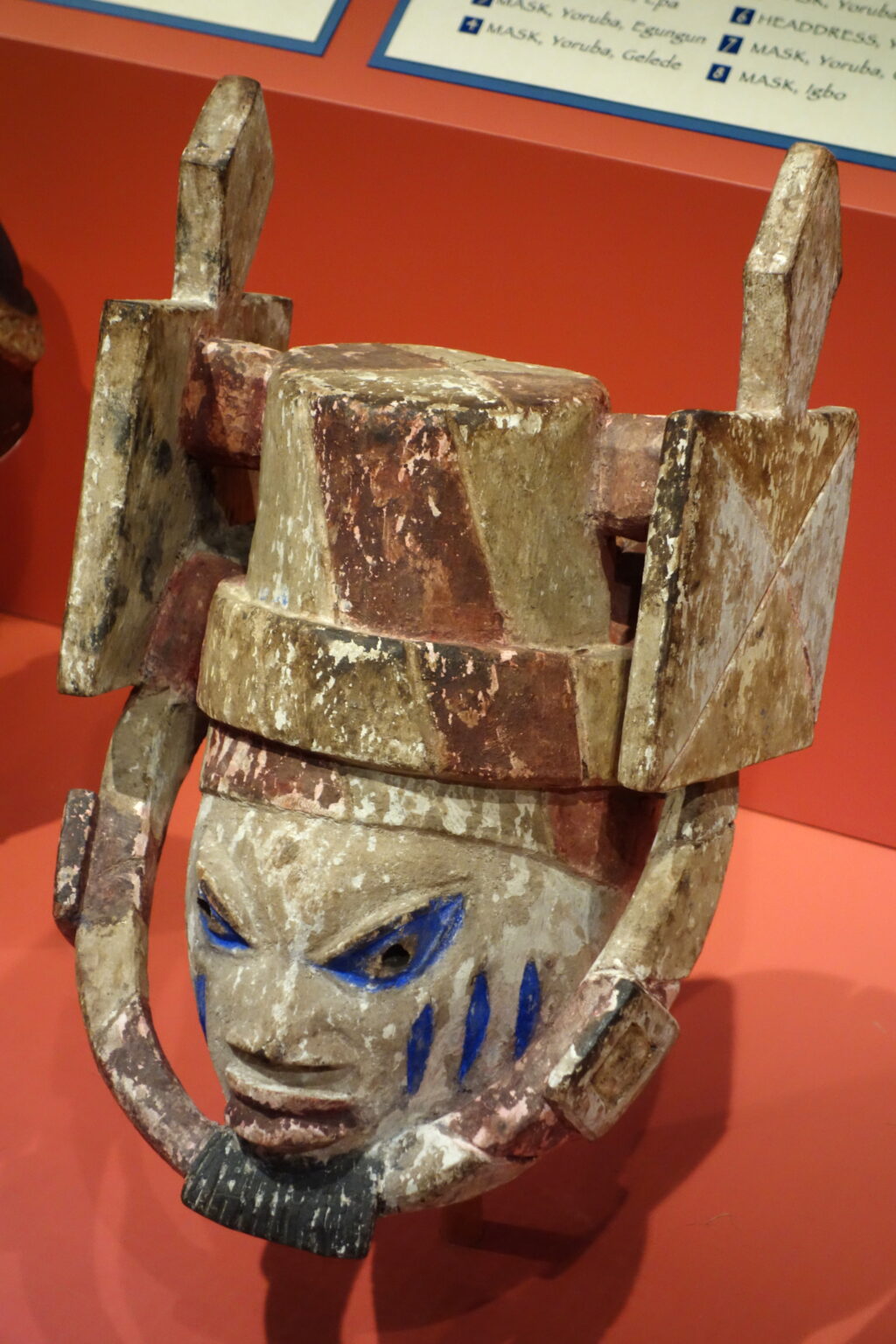
The archive photograph accompanying this feature shows a different Gelede mask in the Glenbow Museum in Calgary, photographed in 2013. It records a museum object, rather than a present-day festival or a performance in Yorubaland.
Archive image: Daderot, Glenbow Museum, 21 September 2013, via Wikimedia Commons, CC0 1.0. Research: UNESCO, Metropolitan Museum of Art and Brooklyn Museum collection records.