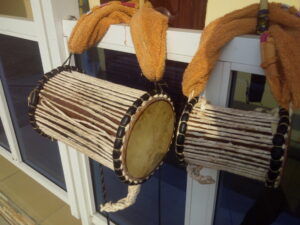
Gángan is a Yoruba talking drum whose changing pitch can follow the tones of speech. It belongs within the broader dùndún drumming tradition. Dùndún names a family of drums and an ensemble, rather than only the smaller instrument commonly called gángan.
The larger ìyáàlù dùndún, or mother drum, leads the traditional ensemble. Gángan is a smaller pressure drum held under the arm. Both can imitate aspects of Yoruba speech, but they differ in size and performance role, as research with Yoruba musicians explains.
The technique depends on tension. Pressure on the cords connecting the drumheads changes the pitch: tightening raises it, while releasing pressure lowers it. The drummer combines those movements with strokes from a curved beater. The Timothy S. Y. Lam Museum of Anthropology at Wake Forest University describes a Yoruba example made from wood, leather, fabric and cowhide.
The museum places the instrument within a wider range of Yoruba drums. Its collection also includes a bàtá associated with ceremonies for Shango and a gudugudu played in dùndún ensembles. The gudugudu has a goatskin membrane sounded with rawhide beaters.
Yoruba speech distinguishes high, middle and low tones, as well as gliding movements between them. A word's meaning can change with its tone. The drum reproduces aspects of that pattern through pitch and timing, although its sound is different from a human voice.
Researchers Cecilia Durojaye and colleagues examined the relationship in a study published in Frontiers in Communication in July 2021. They compared vocal speech and singing with four modes of dùndún performance, ranging from direct imitation of speech to more musical playing.
Three Yoruba speakers recorded speech and songs in an Ibadan studio. Three professional drummers reproduced them on their instruments. Two drummers had about 35 years' experience, while the third had played for 28 years.
Pitch, timing and intensity matched closely when drummers directly imitated speech. The correspondence weakened in more musical modes. The findings distinguished different performance styles rather than treating every rhythm as a literal spoken message.
Another study, published in February 2022, compared dùndún and bàtá speech systems. Mariano González and Olupemi Oludare based their analysis on recordings made in Lagos in February 2020. The drummers performed 12 Yoruba sentences composed by the researchers and previously unknown to them.
The participants included Ayanlere Alajede on ìyáàlù dùndún and Kangan Bamidele on gángan. A native speaker read the sentences aloud. The drummers could take time to absorb them, although the researchers reported that most responses followed immediately, except for some longer sentences.
The study describes ìyáàlù dùndún and gángan as instruments with the same basic construction but different sizes. It distinguishes their flexible tuning from the fixed membranes of bàtá drums. The researchers found that these physical differences supported different ways of translating speech into drummed sound.
Their account also places dùndún in religious settings and urban popular music. Praise poetry, known as oríkì, and proverbs, or òwe, form part of the established performance repertoire. The recording exercise tested the musicians' ability to work beyond familiar texts.
A twentieth-century ìyá ìlù in the Metropolitan Museum of Art records the instrument's construction in wood, cloth, hide and metal. The double-headed drum measures 47.6 centimetres long, with a head diameter of 28.5 centimetres. It entered the collection as a gift from Herbert J. Harris in 1986.
Archive instrument photograph: Yoruba talking drums, 21 January 2017. Bamidele S. Ajayi via Wikimedia Commons, CC BY-SA 4.0. Not a photograph of the research sessions. Resized for display; photographic adaptations retain the same licence.