
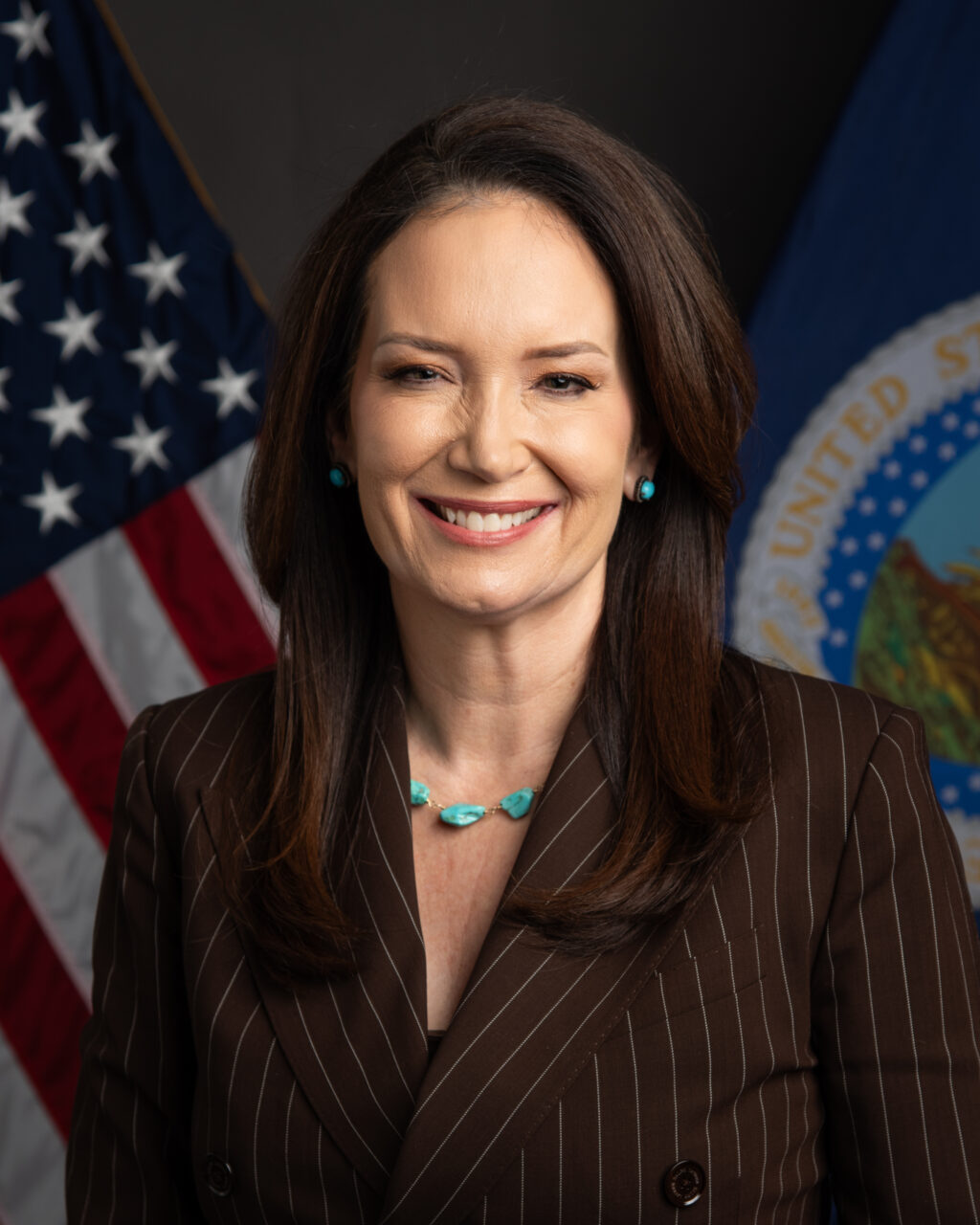
Official portrait of US Agriculture Secretary Brooke L. Rollins, 14 February 2025. USDA photo by Christophe Paul. Public domain as a work of the US federal government. Archive portrait, not a photograph of the 19 November 2026 court proceedings.
A US federal judge has ordered Agriculture Secretary Brooke Rollins to observe limits on religious messages sent to staff through her official account, granting a preliminary injunction after six employees and the National Federation of Federal Employees challenged holiday emails they said placed pressure on workers who did not share her Christian beliefs.
US District Judge Trina Thompson, of the Northern District of California, issued the order on Thursday, 19 November. It requires Rollins to stop if a colleague asks her to stop, not create a hostile work environment through persistent unwelcome advances, and not use official authority to pressure subordinates. It also allows her to discuss her faith with interested colleagues, explain why it is meaningful to her, politely invite co-workers to religious events and express religious views in appropriate conversations.
The ruling is a preliminary injunction, not a final judgment in the case. The court granted relief on the employees’ constitutional claim under the First Amendment’s Establishment Clause, dismissed their separate claims under the Administrative Procedure Act and rejected the department’s attempt to dismiss the constitutional claim. The distinction means the court has imposed interim limits while the central constitutional dispute continues.
Six employees and their union brought the case
The National Federation of Federal Employees and six Department of Agriculture workers filed the case on 13 May 2026. The union represents about 110,000 federal employees, including more than 19,000 USDA workers. The individual employees work in different parts of the department and were not themselves members of the union, according to the court record.
Rollins took office as the department’s secretary on 13 February 2025. The USDA employs approximately 100,000 civil servants, all of whom report to her either directly or through the agency’s management structure.
The lawsuit concerned messages Rollins sent to the department’s workforce from her official email account. The court record identified communications for Independence Day on 4 July 2025, Thanksgiving on 26 November 2025, Christmas on 23 December 2025 and Easter on 5 April 2026.
The judge’s conclusion focused particularly on the Christmas and Easter messages, which she said went beyond holiday greetings and suggested that employees were expected to share the secretary’s Christian beliefs. The Christmas message included a video referring to Jesus Christ as “our Savior”, while the Easter email described the resurrection as “the foundation of our faith” and referred to the agency’s “shared mission”.
Why the judge found a risk of coercion
Judge Thompson identified three features of the communications: Rollins’s authority as a Cabinet secretary, the use of an official account to send messages to the entire workforce, and language that could make employees of other faiths or no religion feel excluded. She said the use of words such as “we”, “us” and “our” could present the secretary’s beliefs as if they were shared by all USDA employees.
The court rejected the argument that workers could simply ignore the emails. Staff were expected to read messages from the head of their department because they could contain important information about reorganisations, relocation requirements, civil rights programmes, shutdown planning and other workplace matters. The judge said that made the communications different from a voluntary conversation between colleagues.
The employees alleged that they felt pressure to conceal their own beliefs or appear to share the secretary’s. One plaintiff said she had been told that removal from the distribution list was not possible and that she would “create trouble” for herself if she continued to object. Those statements were allegations in the case record, not findings that every employee had been threatened.
The judge concluded that the plaintiffs had shown a sufficient likelihood of success on their constitutional claim to justify preliminary relief. She wrote that the messages from December 2025 and April 2026 suggested “acquiescence that amounts to coercive pressure”.
The court pointed to USDA’s own workplace guidance
The order also referred to a USDA workplace memorandum issued on 20 November 2025. The department’s guidance says employees must not use official authority to pressure subordinates over religious beliefs and must stop if a colleague asks them to stop. It also allows appropriate religious expression in conversations with willing colleagues.
Judge Thompson said the secretary should be required to observe the department’s own rules. “The buck stops with Secretary Rollins,” she wrote, noting that the same boundaries should apply to the person at the top of the agency.
The order does not prohibit Rollins from practising her religion or discussing it in her personal capacity. It expressly permits her to speak about her beliefs with interested colleagues, explain the importance of her faith, make polite invitations to religious services and express religious views in suitable conversations. The restrictions concern the use of official authority and workplace communications.
USDA says it is considering an appeal
The Agriculture Department said it was evaluating all options, including a prompt appeal. It described the decision as a “completely unprecedented attempt to muzzle a Cabinet Secretary”. The court’s order does not prevent the department from contesting the case through the normal legal process.
The judge granted the preliminary injunction only on the Establishment Clause claim. She dismissed the employees’ Administrative Procedure Act claims because the emails did not amount to a final agency action under that law. The constitutional claim remains before the court, and the injunction can be revisited as the litigation proceeds.
A further case management conference has been scheduled for 17 December 2026, with the parties required to file a joint case management statement by 10 December. The immediate order sets boundaries for official religious communications while leaving the wider constitutional case to be resolved through the court process.