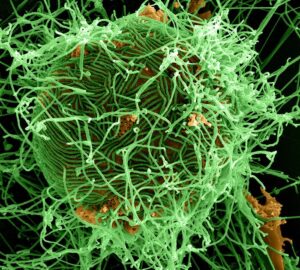
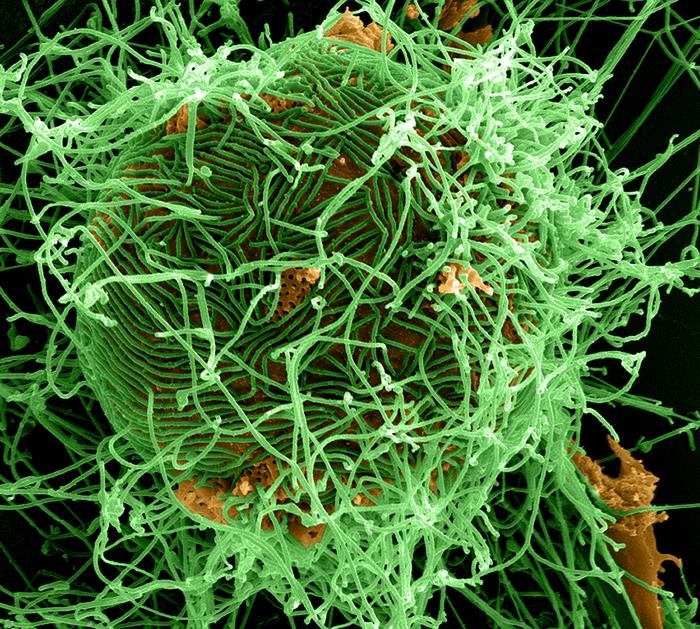
Colourised scanning electron micrograph of Ebola virus particles budding from a chronically infected cell, produced by the US National Institute of Allergy and Infectious Diseases in 2014. Illustrative image, not a photograph of the current outbreak or a specific Bundibugyo virus specimen. Source: CDC Public Health Image Library, PHIL 17771. Public domain; attribution: NIAID.
The World Health Organization has warned that the Bundibugyo Ebola outbreak in the Democratic Republic of the Congo is still expanding, with more than 11,000 cases and 5,400 deaths reported across eight provinces. At a third meeting of the International Health Regulations Emergency Committee on 17 November, WHO Director-General Tedros Adhanom Ghebreyesus said between 400 and 500 new cases were still being reported each week.
The US Centers for Disease Control and Prevention’s situation update, published on 18 November using data through 16 November, recorded 11,536 confirmed cases and 5,635 confirmed deaths across the affected countries. It listed 11,504 cases and 5,630 deaths in the DRC alone. The figures use different reporting cut-offs and should not be treated as identical. The CDC says the outbreak is now the second-largest Ebola outbreak on record.
The outbreak was declared in May and is caused by Bundibugyo virus, a species distinct from the Zaire ebolavirus responsible for several previous Ebola epidemics. WHO declared the epidemic a public health emergency of international concern on 17 May. In his 17 November remarks, Tedros said the number of cases had more than doubled since the committee’s previous meeting three months earlier.
Children are bearing a disproportionate share of the deaths. WHO said they account for more than a quarter of confirmed cases and one third of deaths. Seven in ten children under five with confirmed Ebola have died. “Children are paying a terrible price,” Tedros told the committee.
The location of deaths is also a serious concern for the response. Two-thirds of confirmed deaths are occurring outside Ebola treatment centres, which WHO says indicates that infections are being identified too late. Contact follow-up remains below target. Early access to care, prompt isolation, contact tracing, safe and dignified burials and trusted communication with communities remain central to stopping transmission.
Insecurity is making those tasks harder. WHO said an armed attack on Cantine-Aloya earlier in November killed 66 civilians, including three health workers. Health facilities were looted and burned, more than 1,000 contacts were lost to follow-up and three confirmed cases were unaccounted for. The Director-General also referred to an attack in Tshopo province in which a nurse was killed and another health worker was badly injured while responding to an Ebola alert. WHO’s 15 November regional update said there had been more than 80 attacks on health care since the outbreak was declared.
The attacks have consequences beyond the immediate casualties. When medical teams cannot reach affected communities, they lose opportunities to identify new infections, trace contacts and provide early treatment. Displacement and restrictions on movement add to the difficulty of maintaining surveillance and essential health services. Tedros described insecurity as one of the greatest obstacles to the response.
There has nevertheless been progress in several early outbreak centres. WHO said rapid transmission had been halted in places including Mongbwalu, Nyankunde, Nizi, Rwampara and Butembo. In Bunia, one of the larger early centres, the number of new cases had halved, although transmission continued. Diagnostic capacity has grown from two laboratories at the start of the outbreak to more than two dozen. Close to 2,000 treatment beds are available, and about 3,000 people have recovered.
The wider response includes nearly 100 health and humanitarian partners working in affected areas. WHO reported that more than 17,000 community health workers and 46,000 community actors had been trained and supplied. Almost 90 per cent of registered deaths were being managed through safe and dignified burials, which help reduce the risk of transmission during funeral practices. The organisation has stressed that these gains remain fragile and need to be protected.
Research is continuing, but there is no vaccine approved specifically for Bundibugyo virus. A trial began last month using the Ervebo vaccine, which is approved for a different Ebola virus but not for Bundibugyo. Two candidate vaccines developed specifically for Bundibugyo are due to be added to the trial in the coming weeks. More than 900 people have also enrolled in clinical trials of therapeutics, according to Tedros. He cautioned that vaccines are not a substitute for early care, contact tracing, isolation and community engagement.
The outbreak has also affected neighbouring countries. Kenya has reported nine cases linked to an imported infection, including two deaths. WHO said the last patient had been discharged and the 42-day monitoring countdown had begun. Nigeria has reported one imported case. The European Centre for Disease Prevention and Control said the patient was discharged in Switzerland on 11 November and all 62 identified contacts in Nigeria completed monitoring on the same day. Podium News reported that conclusion in its 15 November article on Nigeria’s contact-monitoring response.
The WHO’s latest warning is therefore not that response efforts have failed everywhere. It is that local gains have not yet brought the wider epidemic under control. The organisation is calling for sustained funding through 2027, safe access for health teams, protection of health facilities and stronger participation by affected communities. Those conditions will determine whether the progress already made can be extended to the areas where transmission is continuing.
Official updates: WHO Director-General’s remarks, 17 November; CDC situation update, 18 November; WHO African Region update, 15 November; ECDC update, 16 November.