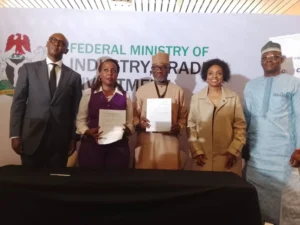
South Korea’s development agency has handed Nigeria the final report of a new national electronic-government plan, setting out a 2026 to 2030 programme intended to connect public institutions and improve access to government services.
The Korea International Cooperation Agency (KOICA) formally transferred the e-Government Master Plan 2.0 to the Federal Ministry of Communications, Innovation and Digital Economy at a ceremony in Abuja on Thursday, 12 November 2026. The handover concludes the agency’s Building Foundations Towards Digital Governance in Nigeria project, but it does not mean the entire plan has been implemented.
KOICA Country Director Kim Eunsub said the completion of the planning phase placed responsibility for the next stage with Nigerian institutions. He identified national ownership, continued investment and coordination between government bodies as requirements for turning the document into operational services.
The plan was developed from May 2022 through consultations with ministries, departments and agencies. It consolidates 25 initiatives from the first e-government master plan into 10 strategic initiatives organised under five pillars: integrated digital infrastructure, sustainable digital government, citizen-centred service transformation, digital governance and institutional reform, and innovation, partnerships and digital capacity.
At the ceremony, Acting Permanent Secretary Koriotaa Okobiah said the ministry intended to move from disconnected digital projects towards a coordinated system in which citizens could deal with government more easily. She said the practical test would be improvements in access, speed and transparency, rather than the completion of a planning document alone.
The ministry identified the National Information Technology Development Agency (NITDA), Galaxy Backbone, the Nigeria Data Protection Commission and the Nigerian Postal Service among the bodies expected to contribute to implementation. Their involvement reflects the range of issues the plan must address, including shared infrastructure, institutional responsibility, privacy and services delivered outside central government offices.
Director of E-Government Johnson Bareyei described the project as an effort to change how public institutions cooperate and use technology. Professor Hung Park of South Korea’s Sangmyung University, who presented the report, outlined its initiatives, implementation roadmap and conditions for success.
According to details provided at the handover, the project has already produced enterprise-architecture work for NITDA, the Nigeria Customs Service, the Nigeria Immigration Service and the National Identity Management Commission. Enterprise architecture is the framework through which institutions organise systems, data and technical processes so that digital services can work together.
An enterprise-architecture portal was handed to NITDA in March 2026. Nigeria also held a soft launch of a single-window Government Service Portal in July. These are reported project milestones, not evidence that all public services are already integrated or that every citizen can use the portal.
KOICA additionally supplied 572 mobile National Identification Number registration devices to the identity commission and the postal service. The stated purpose was to strengthen registration capacity, although the handover report did not establish how many additional registrations those devices had produced.
Training formed another component of the cooperation. The agency said 630 state government officials from six states received support to develop state-level e-government plans, while 69 instructors were trained for the e-Government Training Centre. More than 1,646 public-sector technology professionals participated in four KOICA-supported Devs in Government training sessions.
These activities build on an earlier Korean-supported phase that produced Nigeria’s first e-government master plan and helped establish the training centre. The new report therefore represents a continuation of an existing bilateral programme, rather than a wholly new digital initiative attributed to one administration.
The handover comes as Nigerian public agencies face pressure to make services more accessible and reduce repeated paperwork. The document’s intended benefits will depend on funding, compatible systems, agency cooperation and protection of personal data. No independently audited nationwide performance results were supplied with the handover announcement.
The latest stage was documented by the News Agency of Nigeria on 13 November. Its report records commitments and project outputs described by officials; it does not establish that the 2026 to 2030 targets have already been met.
For citizens and businesses, the next verifiable developments will be the formal adoption of the plan, the publication of funded implementation steps and measurable improvements in services. The completed report gives government institutions a roadmap, while responsibility for delivering the promised changes remains with the Nigerian authorities and their partners.