The Democratic Republic of the Congo has recorded 5,026 confirmed deaths from its continuing Bundibugyo Ebola outbreak, with 10,351 infections reported as health authorities struggle to contain transmission across eight provinces.
The latest figures, released by the country’s health authorities at the end of October, put the reported case fatality rate at approximately 48.6 per cent. Officials also recorded 2,788 recoveries. The outbreak has become the deadliest Ebola emergency in the country’s history and the second deadliest recorded globally, after the West African epidemic of 2014 to 2016.
The outbreak was formally declared on 15 May after laboratory testing identified the Bundibugyo virus in eastern Congo. It has since reached 67 health zones, compared with 66 zones across eight provinces documented by the World Health Organization (WHO) on 23 October. Ituri, where the first confirmed clusters emerged, and neighbouring North Kivu remain among the most heavily affected areas.
Congolese health officials face a difficult combination of persistent infections, displacement and insecurity. In some affected communities, poor roads and attacks on health personnel have disrupted access to treatment and contact tracing. Health workers have also reported shortages of protective equipment and interruptions to payments, placing additional pressure on the teams responsible for finding and caring for patients.
The WHO’s 23 October update showed how serious the delay in reaching treatment had become. Of 482 deaths reported since its preceding update, 307 occurred in communities rather than treatment centres. People who become ill outside the formal care system can be harder to identify quickly, while relatives and neighbours may be exposed before infection prevention measures are introduced.
For individual health workers, the risks are immediate. In an account published by the WHO Regional Office for Africa on 23 October, Dr Prince Afandia Alafu, a doctor in Isiro, described becoming a patient after developing fever and headaches that he initially associated with malaria or typhoid. Testing confirmed Bundibugyo infection. He recovered after receiving care and later returned to see an expanded treatment facility. His experience illustrates the exposure faced by medical staff as they continue working during the epidemic.
Public health agencies say the response cannot succeed through hospital treatment alone. Community volunteers, local leaders and contact tracers remain essential to identifying symptoms early, helping patients seek care and supporting safe burial procedures. In a statement on regional preparedness, Africa CDC Director-General Dr Jean Kaseya said:
“Our response must be African-led, united, transparent and centred on communities.”
The Africa CDC statement also called for stronger cross-border information sharing, laboratory readiness and rapid response teams. Those measures have gained urgency as imported cases have been reported beyond Congo, including in Kenya and Nigeria. Authorities in the affected countries have activated surveillance and contact-tracing arrangements, although their reported case totals and exposure investigations differ.
The Bundibugyo species presents a further challenge because there is no vaccine or specific treatment currently approved for it. The licensed Ervebo Ebola vaccine targets a different virus species, and its effectiveness against Bundibugyo has not been established. WHO guidance therefore restricts its use against this outbreak to research protocols.
There has been an important development in that research. On 23 October, the first participant was vaccinated in Bunia under the Tumaini Phase 2/3 clinical trial, which is assessing candidate vaccines against Bundibugyo. Separate clinical research is investigating potential treatments. The trials may provide evidence for future decisions, but neither constitutes an approved solution to the present outbreak.
In an earlier joint commentary, the leaders of WHO and Africa CDC urged better protection for frontline workers, reliable funding and stronger local participation. They warned that delayed financing and fragmented support leave gaps in surveillance, laboratory testing and patient care. The agencies have also stressed the need to maintain ordinary health services while emergency teams respond to Ebola.
For now, the figures released by Congo’s health authorities show that transmission remains extensive despite months of intervention. The government, WHO, Africa CDC and humanitarian partners are continuing efforts to expand treatment, trace contacts and protect health workers while the vaccine and treatment studies proceed.
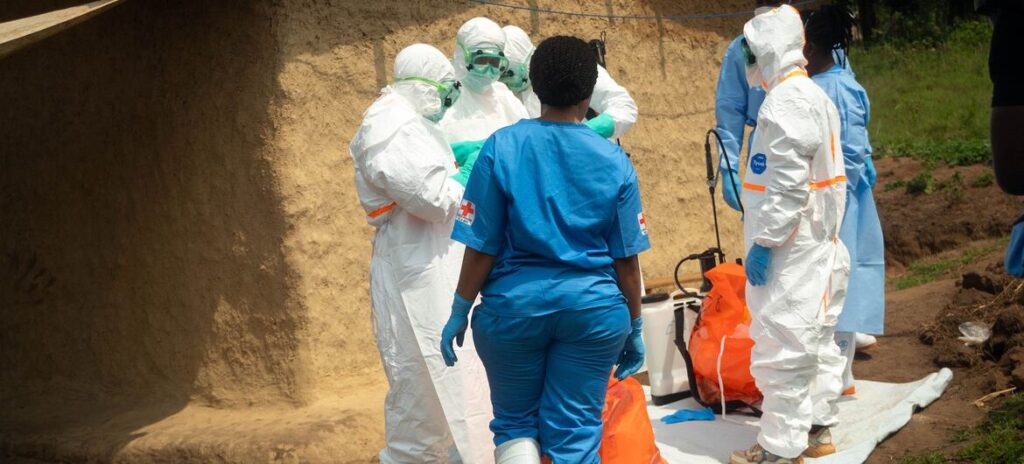
Photograph: Priscilla Lecomte/UNOCHA, Bembi, Democratic Republic of the Congo, 1 September 2026. Archive photograph, reproduced under CC BY-SA 2.0. Image source.