Takete-Ide in Kogi State will hold its centenary celebration from 29 to 31 October 2026. Cultural events, health outreach, education programmes and community fundraising will mark about 100 years at its present settlement.
The community’s published programme identifies Saturday, 31 October, as the main celebration, beginning at 10am at UBE School Field in Takete-Ide, Mopamuro Local Government Area. The gathering forms part of the annual Takete-Ide Day and will include fundraising for local development.
The Takete-Ide Progressive Union’s national president, Prince Richard Dare Fiki, and the central planning committee chairman, Kingsley Femi Fanwo, announced the dates in a joint statement reported by The Nigerian Post on 1 September.
They listed a free medical outreach, a novelty football match, an education summit and a seminar on drug abuse among the planned activities. Historical exhibitions, traditional food, cultural displays and the presentation of a volume on the community’s history are also scheduled.
The organisers said the celebration would provide an opportunity to draw public and private attention to infrastructure needs. They invited indigenes and friends of the community, including those living abroad, to participate.
The anniversary concerns the move to the present site around 1926. It does not mean that Takete-Ide’s history began that year. The community’s own historical account places its earlier settlements and migrations within a much longer story of the Amuro people. “As a people, we are centuries old,” the organisers said.
Takete-Ide belongs to the Amuro district, whose people identify with the Yagba branch of the Okun Yoruba communities. Its historical account describes successive movements through forest and upland settlements before the descent from Ilu-Oke to the plain where the modern community developed.
That account dates the relocation to 1926 or thereabouts, retaining the approximate dating found in the organisers’ announcement. It associates the move with reconnaissance by hunters and deliberations among community elders about water, agricultural land and security. It names Odo Takete, Oke Adan and Oke Ako among the quarters that relocated.
The centenary therefore commemorates a particular stage of settlement. Earlier community life, including the period spent in the hills, remains part of the history being recalled. The community also records a later movement towards Takete-Tedo, in the Okegada area, from 1949.
Organising work extends beyond the town itself. The Takete-Ide Progressive Union describes its role as connecting indigenes at home, elsewhere in Nigeria and overseas around heritage and community development. Its documented network includes branches in Lokoja and Ilorin and a UK and Europe chapter.
The union operates alongside the traditional institution, with a separate responsibility for branch activities and union-led projects. Its stated areas of work include roads, security, education and civic infrastructure. The centenary programme brings those development concerns into the annual reunion.
Oba Philip Ebilakun, the Olu’de of Takete-Ide, and the traditional council are involved in preparations, according to the organisers’ statement. The published invitation calls on community members and their friends to support the celebration.
The announcement gives dates for the three-day programme but does not assign times to the medical outreach, education summit, football match or individual cultural activities.
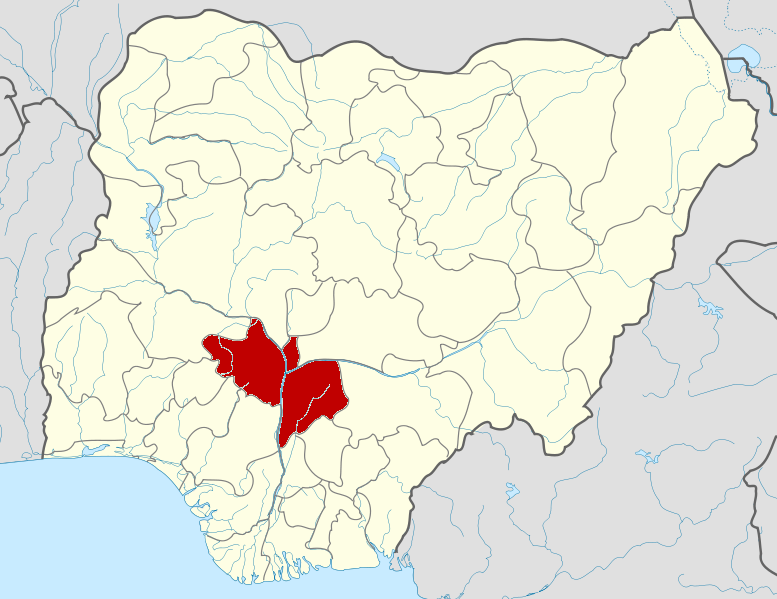
Illustrative locator map of Kogi State, 11 February 2010, not a festival photograph or venue map. Himalayan Explorer, based on work by Uwe Dedering, via Wikimedia Commons, CC BY-SA 3.0. Low-resolution archive, 777 × 599 pixels.