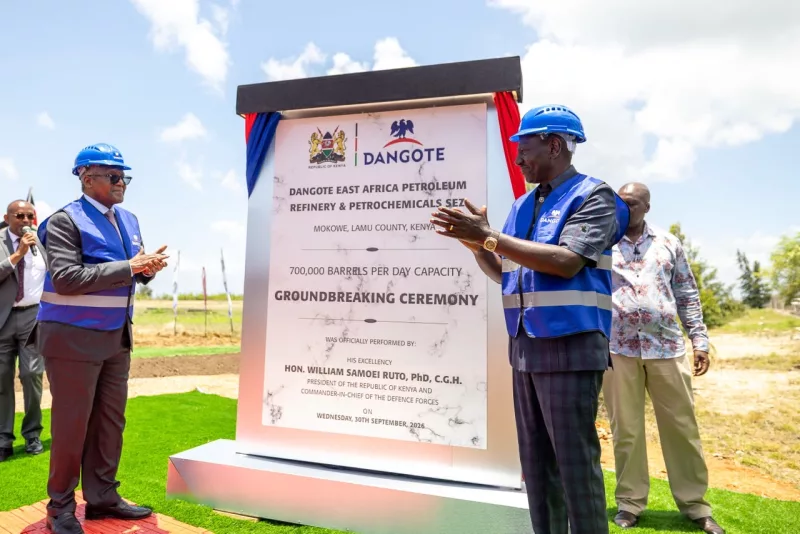
Nigerian industrialist Aliko Dangote has broken ground on a $16 billion oil refinery in Lamu, Kenya, moving the planned 700,000-barrel-a-day complex from announcement to launch even as landowners and a consumer-rights group pursue separate legal challenges.
The ceremony on Wednesday, 30 September, brought together Kenyan President William Ruto, regional leaders and former Nigerian President Olusegun Obasanjo. Kenya’s government described the development as a major industrial project intended to strengthen the country’s manufacturing base and the wider Lamu Port South Sudan Ethiopia Transport corridor.
The groundbreaking is a material development since Podium News reported on 29 September that a Kenyan court had ordered the status quo to be maintained on disputed land connected to the project. The court did not prevent the ceremonial launch, but site activities may still be affected before the parties return for a hearing on 14 October.
A second challenge has now been filed by the Consumers Federation of Kenya. The group is seeking disclosure of key details about the proposed government stake, including the acquisition vehicle, share class, payment terms and evidence of public participation. It also wants any approvals found to be non-compliant to be reconsidered.
A refinery built for a regional market
The planned refinery is designed to process 700,000 barrels of crude oil each day. At that scale, it would rank among Africa’s largest refining facilities and would be comparable with Dangote’s existing refinery in Lagos.
Kenyan officials say the Lamu complex will include a 1,000-megawatt power plant as well as fertiliser and chemical manufacturing facilities. The refinery is expected to produce petrol, diesel and jet fuel for Kenya and other East African markets, with some products potentially exported farther afield.
Dangote has offered regional governments a combined stake of up to 30 per cent and has said the project will prioritise crude produced in East Africa. The scheduled completion date is 2030, while officials at the ceremony also spoke of a 40-month construction programme.
The Nigerian company has selected Engineers India Limited for a major engineering contract and Honeywell Technologies to provide engineering services, licensing and equipment. Those partnerships give the project experienced technical support, but they do not remove the challenges associated with financing, land access, energy infrastructure and a construction programme of this scale.
For East African economies, the commercial argument is straightforward. The region imports large quantities of refined petroleum products, placing pressure on foreign exchange reserves and exposing consumers to international supply disruptions. A major regional refinery could shorten some supply chains and keep more processing value within Africa.
Dangote used the launch to renew his call for greater African industrialisation. He said the continent should process more of what it produces instead of continuing to export raw materials and import finished goods.
Jobs, investment and difficult questions
Kenya has presented the refinery as its largest foreign direct investment and expects it to create jobs, develop technical skills and stimulate new businesses around Lamu Port. Officials have also argued that the project could attract petrochemical, logistics and manufacturing activity to the area.
Those expectations will be closely watched. Large infrastructure projects often generate impressive headline employment estimates, but the lasting public benefit depends on how many jobs go to local residents, whether workers receive recognised training and how much procurement reaches Kenyan and regional businesses.
The refinery is also likely to reshape competition in Africa’s fuel market. Dangote’s Lagos facility has already changed Nigeria’s position from a major importer towards a growing exporter of refined products. Replicating that model on the Indian Ocean coast could extend the group’s influence across East Africa and give the company access to a large regional market.
However, the Lamu project begins under legal and social pressure. More than 130 residents have gone to court claiming ancestral rights to land connected to the development. They are seeking recognition of their interests, protection of homes and cultural sites, and clarity on compensation and resettlement.
Environmental campaigners have also raised concerns about fragile coastal and marine ecosystems near Lamu, including the potential consequences of industrial activity close to a historically and environmentally sensitive area.
The new consumer-rights petition adds a transparency issue. Its demands concern the proposed public investment and whether citizens received sufficient information and an opportunity to participate before commitments were made. Dangote Group and the Kenyan government had not publicly responded to the latest petition when the challenge was reported.
Why the legal process matters
The disputes do not erase the refinery’s potential, but they place a responsibility on the company and the authorities to show that industrial ambition can coexist with land rights, environmental safeguards and public accountability.
The 14 October court hearing will be an important test. It may clarify what activities can proceed on the disputed land and what evidence the parties must provide. The separate consumer petition could also force greater disclosure about ownership and financing arrangements.
For Nigeria, the project represents a significant expansion by one of its largest industrial groups and another attempt to export the country’s refining experience. It also raises a wider question about how Nigerian capital can grow across Africa while meeting local legal, environmental and community expectations.
The groundbreaking shows that Dangote and Kenya are determined to advance the refinery. Its real measure of success, however, will not be the ceremony or the size of the investment alone. It will be whether the facility is completed responsibly, delivers reliable energy and creates durable benefits for the communities and countries expected to support it.
Podium News readers can follow the 14 October hearing for the next legal milestone and share their views on how major African projects should balance industrial development with transparency, environmental protection and community rights.