
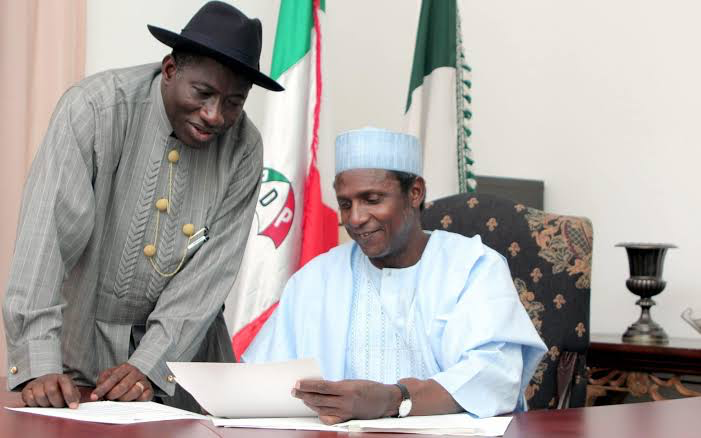
Former President Goodluck Jonathan has revealed that the late President Umaru Musa Yar’Adua did sign a letter authorizing him to act as president during Yar’Adua’s prolonged illness, but the document was never delivered to the national assembly by the aide entrusted with it.
In an interview reflecting on his memoir My Transition Hours, Jonathan described the period as one of the most turbulent in Nigeria’s democratic history, marked by ethnic, religious, and constitutional tensions. He explained that while Yar’Adua’s illness created a power vacuum, the political climate made it difficult to formally transfer authority, especially given the unwritten agreement for the north to hold power for eight years.
Jonathan recounted that although the letter was written, the person responsible for submitting it withheld it, leaving the country in a constitutional crisis. As vice-president, Jonathan could perform some executive functions but could not act as commander-in-chief without a formal transfer of power. This ambiguity led the national assembly to invoke the “doctrine of necessity,” allowing Jonathan to become acting president and preventing a further escalation of the crisis.
He recalled the tense atmosphere at the time, with frequent rumors of coups and concerns for his personal safety. Despite advice from friends to leave the presidential villa, Jonathan chose to remain, stating he preferred to face any danger openly rather than risk speculation about his actions or safety.
Jonathan’s account highlights the critical role of the doctrine of necessity in stabilizing Nigeria during a period of uncertainty and underscores the behind-the-scenes challenges that shaped the nation’s leadership transition.