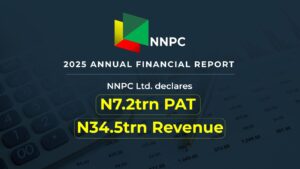
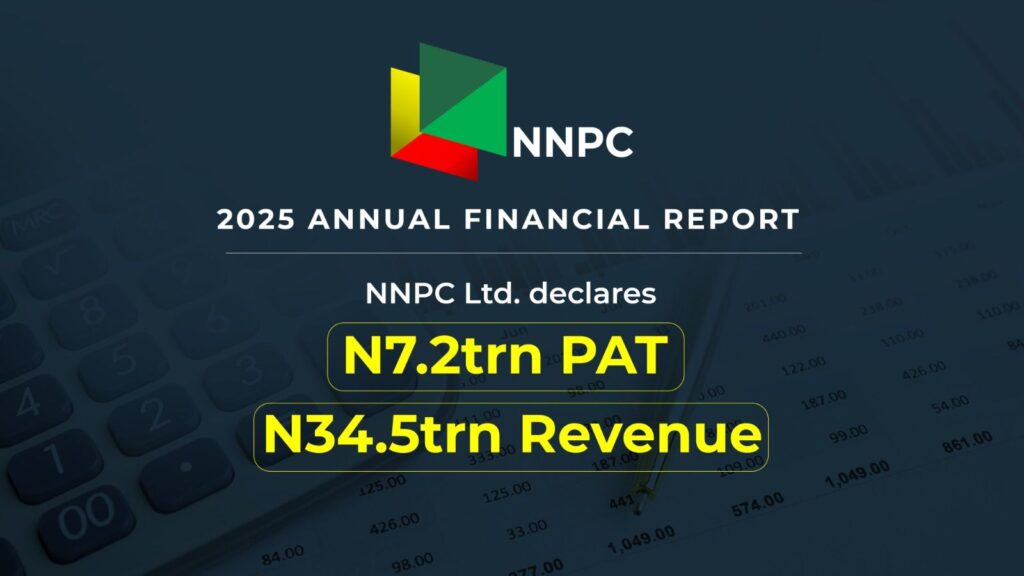
NNPC Limited has reported a ₦7.2 trillion profit after tax for 2025, up 33 per cent from the previous year, despite a sharp fall in revenue. The state-owned energy company also declared a ₦5.8 trillion dividend.
The results, announced on 29 September 2026 following its annual general meeting and an earnings call, cover the financial year ended 31 December 2025. They are not a measure of the company’s earnings so far in 2026.
Revenue fell 24 per cent to ₦34.5 trillion. NNPC attributed the decline mainly to lower crude prices and reduced volumes of refined petroleum products following market deregulation. Operating cash flow rose 16 per cent to ₦12.8 trillion.
The combination of higher profit and lower sales makes the release important beyond the oil industry. It raises questions about how earnings are generated, how much cash can be distributed and what resources remain available for investment.
Group Chief Executive Officer Bashir Bayo Ojulari said: “Our 2025 performance shows what disciplined execution and a capable workforce can deliver.”
NNPC’s earlier announcement for 2024 reported ₦5.4 trillion in profit on ₦45.1 trillion of revenue. Comparing those figures with the latest release shows a ₦1.8 trillion increase in profit and a ₦10.6 trillion reduction in revenue.
What the financial figures mean
Those movements illustrate why revenue and profit should not be treated as interchangeable. Revenue measures income from sales, while profit reflects the amount left after recognised costs and other accounting items. A company can become more profitable even as sales decline.
Cash flow provides a further perspective. Accounting profit does not always become cash in the same period, because customers may owe payments and expenses may be recognised before or after cash changes hands. The reported operating cash flow therefore deserves attention alongside the headline profit.
NNPC’s dividend declaration is consequential for its government shareholders. However, a declared dividend should be distinguished from cash already received by the public treasury. The announcement does not establish when every payment will be completed.
Public scrutiny should focus on both the size and timing of distributions. Transparent information about payments helps citizens understand how commercial earnings contribute to public finances, while avoiding the impression that a company’s entire revenue is available for government spending.
NNPC became a commercial company in July 2022 under the Petroleum Industry Act. That change placed greater emphasis on profitability and investment discipline, but the company’s public ownership keeps its performance a matter of national interest.
A profitable company still faces choices about how much to distribute and how much to retain. Investment in maintenance, production and infrastructure can require substantial funding. Distributing earnings without considering those needs could weaken future performance.
Conversely, retaining money for investment creates an obligation to explain where it goes. Shareholders and the public should be able to assess project costs, completion schedules and the commercial benefits expected from major spending decisions.
NNPC’s strategic direction predates this week’s results. In November 2025, it outlined plans to mobilise $60 billion of investment across the energy value chain by 2030. The roadmap included higher oil and gas output and major pipeline projects.
Those ambitions remain targets rather than completed achievements. A proposed investment pipeline is also different from financing that has been secured and spent. Progress should be measured through identifiable projects and verified delivery milestones.
Why the results matter to Nigerians
For households and small businesses, stronger corporate earnings do not automatically mean cheaper petrol or more reliable electricity. Those outcomes depend on additional decisions about supply, infrastructure, market conditions and how public resources are used.
The results should therefore be read as a commercial performance report, with potential implications for public revenue and future energy investment. They should not be presented as evidence that consumers have already experienced improvements in affordability.
The next step is detailed scrutiny of the accounts and the company’s explanation of its earnings. Clear reconciliation between revenue, costs, cash generation and shareholder distributions would help make the headline numbers more meaningful.
NNPC’s latest report shows a stronger bottom line during a weaker revenue year. Sustaining that performance will require investment decisions that can be tested against delivery, alongside transparent reporting on the money returned to shareholders.
Readers with verified information about the effects of energy investment on businesses and communities can share it with the Podium News newsroom.