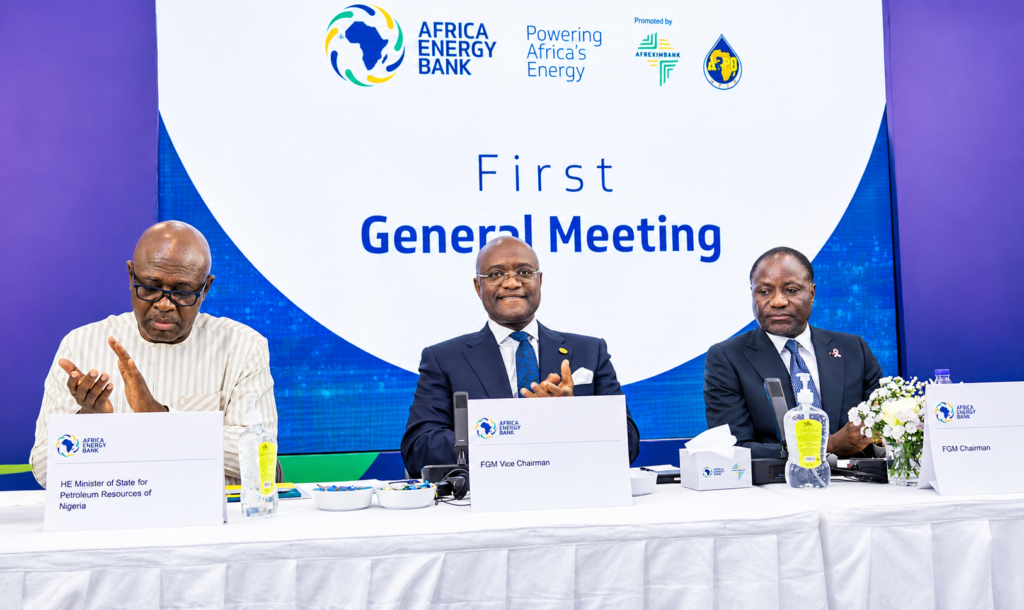
The African Export-Import Bank (Afreximbank) and the African Petroleum Producers’ Organisation (APPO) have formally established the Africa Energy Bank at an inaugural general meeting in Abuja, giving the continent a new institution intended to finance energy projects as international lenders reduce their exposure to fossil fuels. The meeting took place on Saturday, 31 October 2026, and approved the bank’s first leadership and governing board.
The new institution has authorised capital of $5 billion, according to a joint statement issued by its founders. That figure describes the capital authorised for the bank, not an announcement that $5 billion has already been paid in, deposited or made available for immediate lending. The statement did not disclose a first loan, a complete shareholder register or the amount of capital already subscribed.
Delegates at the Abuja meeting appointed Egyptian banker Helmy Ghazi as the Africa Energy Bank’s inaugural president. They also constituted its first board of directors, drawing representatives from public and private institutions and policy organisations. The founders said the bank would operate independently as a supranational pan-African financial institution.
APPO and Afreximbank intend the bank to finance projects throughout the energy supply chain, from exploration and production to transport, processing, refining and distribution. Their stated objectives include expanding African participation in energy investment, strengthening domestic processing and reducing reliance on imported petroleum products.
The institution is expected to seek investment from governments, national oil companies, commercial and development finance institutions, and private investors. Its promoters have not yet announced a timetable for receiving project applications or for making the first financing decisions. Establishing the bank’s governing structures is therefore an important institutional step, but not evidence that any particular energy project has received funding.
The joint statement placed Africa’s energy investment requirements at an estimated $200 billion. It argued that the retreat of some traditional financiers from oil and gas has complicated access to long-term capital, even while petroleum remains an important part of many African economies. The estimate is the founders’ assessment of financing needs, rather than the amount the new bank has raised.
“The Africa Energy Bank aims to bridge this financing gap while supporting a just energy transition for African countries,” the founders said in their joint announcement.
The choice of Abuja as the venue reflects Nigeria’s role in preparations for the institution. Earlier this year, Nigerian officials handed over premises intended to house the bank’s operations. The formal founding meeting followed a series of proposed start dates that had been delayed while the promoters worked on the institution’s structure and capital arrangements.
Nigeria’s Minister of State for Petroleum Resources (Oil), Heineken Lokpobiri, attended the inaugural meeting alongside Afreximbank President George Elombi and Côte d’Ivoire’s Minister of Mines, Petroleum and Energy, Mamadou Sangafowa-Coulibaly. APPO represents African petroleum-producing countries and works to coordinate policy and cooperation among them.
Afreximbank, headquartered in Cairo, is an established multilateral trade-finance institution. Its joint statement said its assets and contingencies exceeded $54.1 billion at the end of September 2026, with shareholder funds of $9 billion. Those figures describe Afreximbank’s own financial position and should not be mistaken for the new energy bank’s balance sheet.
For governments and businesses seeking to develop refineries, pipelines or other energy infrastructure, the new bank offers the prospect of an additional financing route. The practical impact will depend on the capital it secures, the terms it offers, its lending safeguards and the projects it eventually approves. None of those outcomes can be measured from the founding announcement alone.
The bank’s emphasis on oil and gas also places it within a continuing debate about Africa’s energy transition. Its founders say hydrocarbon investment remains necessary for industrial development and energy security, while the global movement away from fossil-fuel financing is accelerating. The announcement referred to a just transition but did not set out detailed lending targets for renewable energy or emissions reduction.
The founders also linked energy investment to expanding industrial production and the electricity demands of emerging technologies. That argument reflects the importance of dependable power for factories, transport systems and digital infrastructure, although the bank has yet to publish a portfolio showing how it will distribute financing across sectors or countries.
The Africa Energy Bank’s establishment marks the completion of a formal governance milestone after years of planning. Its next publicly verifiable measures of progress will be the disclosure of subscribed capital, operating arrangements and actual financing approvals. For now, its confirmed achievements are the founding agreement, appointment of Helmy Ghazi and creation of an inaugural board.
Photograph: Afreximbank, inaugural general meeting in Abuja, 31 October 2026. Founders’ statement.