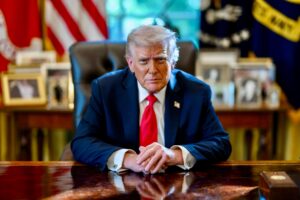

Archive portrait of former Vice-President Atiku Abubakar, photographed on 15 September 2022. Source: Etauso, Wikimedia Commons, CC0 1.0 Universal Public Domain Dedication. This is not a photograph of the 2027 election-technology petition or a current event.
The Federal High Court in Abuja has rejected former Vice-President Atiku Abubakar’s application to amend his suit challenging President Bola Tinubu’s eligibility for the 2027 presidential election, ruling that the proposed changes would introduce fresh evidence outside the constitutional time limit for pre-election matters.
Justice Inyang Ekwo dismissed the application on Friday, 20 November, after hearing arguments from Atiku and the African Democratic Congress (ADC), and from the defendants: Tinubu, the All Progressives Congress (APC) and the Independent National Electoral Commission (INEC).
The ruling does not determine the substantive allegation against Tinubu, nor does it disqualify him from the 2027 election. The main case remains before the court, which fixed 2 December for its hearing.
Atiku and the ADC filed the suit in August, asking the court to disqualify Tinubu and the APC from the presidential election. They alleged that the APC submitted a forged National Youth Service Corps (NYSC) discharge certificate to INEC in support of the president’s nomination. The plaintiffs have questioned the name and details on the certificate they say was submitted to the electoral commission.
The defendants deny the allegation. Tinubu and the APC told the court that they did not submit the Form CF001 cited by the plaintiffs for either the 2023 or 2027 election. They also said the NYSC had never denied issuing Tinubu’s discharge certificate. INEC separately challenged the competence of the suit and the plaintiffs’ legal standing.
Atiku’s application sought permission to amend the originating summons and supporting material. The plaintiffs said they wanted to correct errors in their court documents, provide clearer copies of exhibits, set out further particulars and include a written deposition by Atiku. They argued that the proposed changes would not introduce a new cause of action or additional reliefs.
Tinubu, the APC and INEC opposed the request, arguing that the proposed amendments went beyond correcting mistakes and would introduce new facts after the constitutional period for bringing a pre-election challenge had expired.
In his ruling, Justice Ekwo agreed with the defendants that the application sought to introduce fresh evidence and materially alter the original case. He said pre-election matters are subject to strict constitutional timelines and that parties must present the relevant facts and documents within the prescribed period.
“This is a time-bound suit and the law makes it mandatory for all exhibits to be filed in court within 14 days of occurrence of the event being challenged,” the judge said. He added that material filed outside that period was “null and void and of no effect”.
“I find no merit in this application to bring fresh exhibit, it is hereby refused for being against the express provision of the law,” Ekwo ruled, before dismissing the application.
The judge also rejected the argument that the proposed amendments would not introduce fresh issues. He said an examination of the application showed that the plaintiffs sought to replace existing evidence with new material, rather than simply correct drafting or clerical errors. Allowing the changes, he held, would alter the character of the case and prejudice the defendants.
The decision was limited to the application to amend. The court did not decide whether the NYSC certificate was genuine, whether any party submitted a forged document, or whether Tinubu meets the constitutional requirements to contest the election. Those questions remain part of the substantive proceedings, subject to the evidence and arguments that the court permits.
The suit is marked FHC/ABJ/CS/1888/2026. Atiku and the ADC named Tinubu, the APC and INEC as the first, second and third defendants respectively. In their response, Tinubu and the APC urged the court to dismiss the action, while INEC raised objections including the timing of the case, locus standi and compliance with the Federal High Court’s 2026 Pre-Election Practice Directions.
The court’s next scheduled hearing is 2 December. The parties will then return to the substantive case, which seeks to prevent Tinubu and the APC from appearing on the list of candidates and parties for the 2027 presidential election.