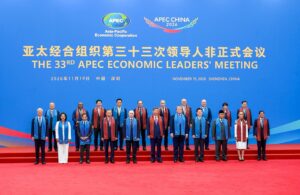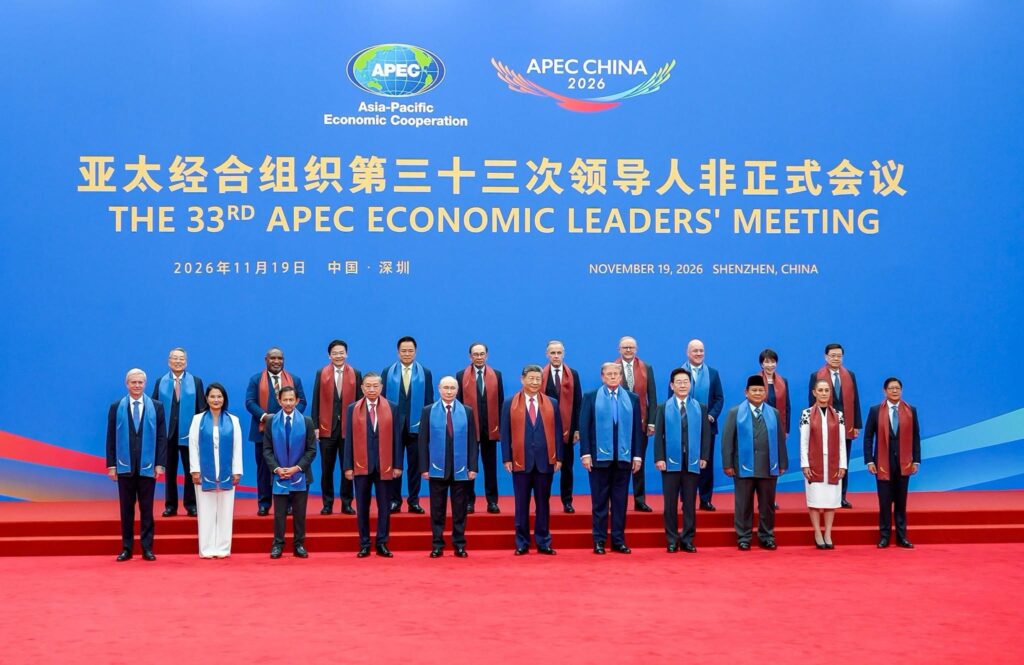
APEC leaders pose for a group photograph before the 33rd APEC Economic Leaders' Meeting in Shenzhen, China, on 19 November 2026. This is a summit group photograph, not a photograph of the closed-door trilateral talks.
Chinese state media published a four-point “peace declaration” on Thursday after the first-ever trilateral meeting between US President Donald Trump, Chinese President Xi Jinping and Russian President Vladimir Putin, setting out broad commitments on United Nations reform, energy supply, international courts and nuclear risk. Russian state media later issued the same text.
The declaration said the three leaders had exchanged views on the international situation and committed themselves to maintaining strategic stability and international security. Russian officials and Chinese state media described the points as agreements by the three countries, including cooperation on United Nations reform, increased fuel supplies and dialogue to reduce nuclear risks.
The status of the document was initially unclear. Chinese state media described it as a “peace declaration by the Chinese, Russian and US leaders”, while reporting from Shenzhen said it was not immediately clear whether the text was the joint statement expected after the meeting or a separate account. Russian state media subsequently published the same declaration, strengthening the indication that it was the statement anticipated by the two governments.
The meeting took place at Kylin Villa in Shenzhen on the sidelines of the Asia-Pacific Economic Cooperation summit. It was the first face-to-face trilateral meeting of the three leaders in this format and lasted about 90 minutes, according to Chinese state media.
Four areas of cooperation
The first point commits the United States, China and Russia, as permanent members of the UN Security Council, to promoting reform of the organisation. The stated aim is to make the United Nations more responsive to global challenges and better able to fulfil its central responsibility for international peace and security.
The declaration does not specify what changes the three countries would support. It gives no proposal on the composition of the Security Council, the use of veto powers or a timetable for negotiations. The commitment therefore sets out a shared objective rather than a detailed reform plan.
The second point says the three countries plan to increase the production and supply of refined petroleum products for the benefit of all nations. It also reaffirms the importance of stable energy flows. The text does not identify production targets, supply volumes, participating companies, delivery routes or a date for implementation.
The third point concerns state consent and the immunity of state officials. The declaration describes both principles as important and says the International Criminal Court and similar bodies must not abuse their jurisdiction.
The provision follows Trump’s criticism of the ICC during the summit, when he described the court as “out of control”. Putin is subject to an arrest warrant issued by the court in March 2023 over alleged war crimes involving the unlawful deportation and transfer of Ukrainian children from occupied areas of Ukraine to Russia. The declaration does not mention Putin’s case or refer directly to the warrant.
The fourth point states that “a nuclear war cannot be won and must not be fought”. It says the three countries will engage in dialogue to reduce nuclear risks and prevent the spread of nuclear weapons.
Nuclear talks face a difficult starting point
The declaration comes after the expiry of the New START treaty on 5 February 2026. The agreement had placed limits on deployed strategic nuclear weapons held by the United States and Russia and provided a framework for monitoring compliance. Its expiry left the two countries without a binding treaty imposing those limits.
The nuclear balance between the three countries is unequal. Estimates cited in reporting on the summit put the US and Russian stockpiles at more than 5,000 warheads each, compared with more than 600 held by China. Washington has sought a future arms-control arrangement that includes Beijing, while China has resisted joining negotiations on the same terms as the two countries with much larger arsenals.
The new declaration does not announce a disarmament agreement, a replacement for New START or a timetable for negotiations. It also provides no verification arrangements or mechanism for measuring progress. The commitment to dialogue is therefore a starting point, not a substitute for a formal arms-control framework.
Ukraine and Iran absent from the declaration
The four-point text makes no reference to the wars in Ukraine or Iran, although Trump had said he wanted to raise both conflicts. Putin spoke at the meeting about shared interests in resolving regional disputes, including the war in Ukraine, but the declaration contains no ceasefire proposal, peace process or commitment directed at either conflict.
The omission leaves a gap between the issues discussed publicly and the commitments set out in the document. Ukraine was not represented at the trilateral meeting, and the declaration does not explain how the three governments intend to involve countries directly affected by the conflicts they discussed.
The statement provides a common set of principles on energy, international institutions and nuclear risk, but it does not set out a negotiating schedule, an implementation plan or a binding agreement. Its practical value will depend on whether the three governments follow the declaration with specific proposals and sustained talks.