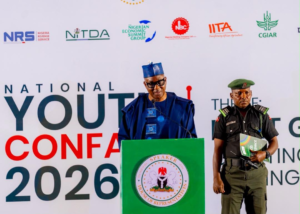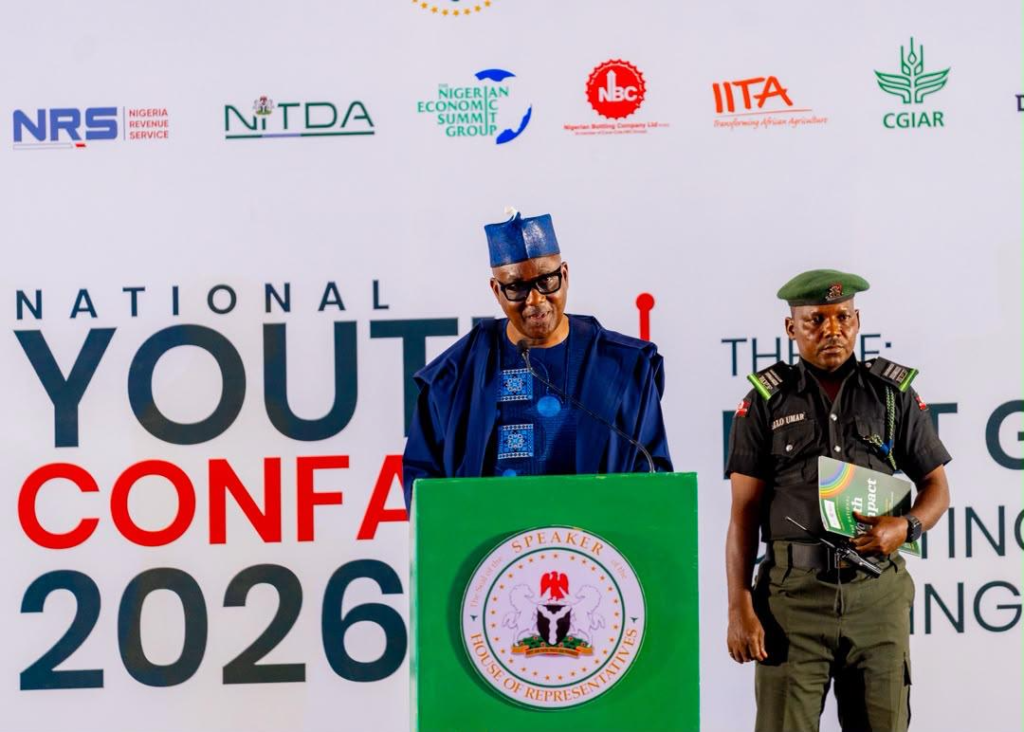
President Bola Tinubu has directed Nigeria’s Minister of Youth Development to draw up an implementation framework for recommendations from the 2026 National Youth Conference, requiring government agencies and other partners to identify priorities, responsibilities, timelines and measures of progress.
The directive was contained in the President’s address at the conference’s closing ceremony in Abuja on Monday, 9 November 2026. Speaker of the House of Representatives Tajudeen Abbas delivered the speech on Tinubu’s behalf, according to the text released by the State House.
Tinubu instructed Youth Development Minister Ayodele Olawande to work with relevant ministries, departments and agencies, state governments, private businesses and development partners. The proposed framework is intended to convert conference recommendations into actions that can be tracked, rather than leaving them solely as a record of discussions.
The President also called for young Nigerians to participate in the implementation and monitoring of the recommendations. The address did not announce a completed framework, provide a publication date for it or specify funding for the proposed measures.
Delegates from across Nigeria and beyond attended the conference, while other young Nigerians contributed through virtual consultations, the President said. The gathering was organised as a national forum for young people to raise concerns and propose solutions on issues affecting their lives.
Employment, living costs, access to education, opportunities to establish businesses and community security were among the concerns identified in the presidential address. Tinubu acknowledged that young Nigerians expected government policies to produce tangible improvements in their prospects.
“I do not want the recommendations of this Conference to become another report gathering dust on government shelves,” the President said in the prepared address. He added that the implementation framework should establish measurable indicators of progress.
The speech also called for the process to include young women, people with disabilities and young people living in rural communities. Tinubu said participation should continue beyond the conference itself, including during decisions about how agreed recommendations are put into practice.
The President referred to several existing federal programmes as part of his administration’s response to barriers facing young Nigerians. They included the Nigerian Education Loan Fund, the Three Million Technical Talent programme, YouthCred and the Nigerian Youth Academy.
Those initiatives cover different aspects of education, skills and access to opportunities. Their mention in the speech did not amount to an announcement of new funding or a verified assessment of their outcomes. The State House statement did not provide new figures for enrolment, loan disbursements, employment or business creation under the programmes.
The conference’s conclusion therefore leaves a specific administrative task with the youth development ministry. The minister is expected to coordinate with bodies whose responsibilities span education, employment, enterprise and other issues raised by participants.
The involvement of state governments and private sector organisations could require agreements across institutions with different powers and budgets. The presidential directive sets out the intended coordination process but does not establish that those arrangements have already been completed.
Tinubu described the conference as an opportunity for young Nigerians to contribute to decisions affecting their future. He said their recommendations would receive government attention and urged participants to remain engaged in public affairs after returning to their communities.
The State House has published the full text of the address, including the instruction to produce an implementation framework. Further details of the recommendations adopted, the responsible institutions and the timetable for delivery will depend on the ministry’s subsequent work.