Democrats have expanded their gains from the 2026 United States midterm elections into state governments, taking control of the Texas House of Representatives and securing unified control of government in several battleground states. The state-level results add to the party’s projected victories in both chambers of Congress, although individual election results remain subject to the normal certification process.
In Texas, Democrats won control of the state House for the first time since Republicans took over following the 2002 election. Republicans retained the state Senate, while Democrat Gina Hinojosa won the governorship, ending a long Republican hold on that office. The combination gives Democrats important new leverage over state legislation without giving them complete control of the Texas legislature.
The results mark a substantial change in a state where Republicans had expected redistricting to strengthen their position. Texas had also been among the states targeted in the battle for congressional seats. The outcome illustrates that a party can gain the governorship and one legislative chamber while its opponents continue to control the other chamber.
According to election results and statehouse reporting compiled by the Associated Press, Democrats secured or retained the governorship and both legislative chambers in Michigan, Minnesota, Pennsylvania, Wisconsin and Nevada. These arrangements, often described as unified or trifecta government, allow a party to advance legislation without needing the opposing party to control a chamber or the governor’s signature.
Wisconsin was particularly significant. Democrats retained the governor’s office and gained both legislative chambers, ending a 16-year Republican majority. In Pennsylvania, the party secured the governor’s office and both chambers at the same election for the first time since 1992. Nevada’s Democratic legislative majorities were joined by a Democratic victory for governor.
Democrats also gained governorships in Georgia, Iowa and Ohio, as well as Texas. The Associated Press reported that the party was positioned to hold at least 28 governorships in 2027. The final balance of some offices was still developing, and the Kansas governor’s race had not been called by the AP at the time of its latest state-government assessment.
The change extends beyond who occupies governors’ mansions. Democrats broke or prevented Republican supermajorities in legislative chambers across eight states, including Florida, South Carolina, Indiana, Missouri, Iowa, Ohio, Kansas and North Carolina. Such changes can matter even where Republicans retain legislative control, because a supermajority may be needed to override a governor’s veto.
State governments have substantial authority over education budgets, healthcare programmes, housing rules, taxes, policing, reproductive rights and the regulation of emerging technologies. Democratic candidates campaigned heavily on living costs, including groceries, housing, energy and healthcare. Their electoral victories now create expectations for legislative decisions rather than campaign promises.
In Pennsylvania, Governor Josh Shapiro identified public transport funding, a higher minimum wage, housing construction and constitutional protection for abortion rights among his priorities following the election. These remain policy objectives, not measures already enacted as a consequence of the vote.
Incoming Democratic governors have not all promised the same approach. Minnesota’s Amy Klobuchar and Wisconsin’s David Crowley have spoken of working with Republicans, underscoring the distinction between an election victory and the practical work of governing. Lawmakers will also face existing budgets, legal constraints and the differing political circumstances of each state.
For Nigerians and other Africans living in the United States, the state results deserve attention alongside the congressional contests. Decisions on schools, professional licensing, transport, housing and access to public services are frequently made at state level. Immigration law is principally federal, however, and the statehouse results should not be presented as an immediate change to federal visa or immigration policy.
The victories also reopen questions about future congressional district maps. Both parties have contested redistricting decisions, and new state majorities may consider changes where legally permitted. Any proposed map would require its own legislative and legal process; the election outcome does not itself redraw a district.
The Associated Press described the overall state-level shift as the largest single-election change in partisan control of state governments since 2010. The new officeholders and legislatures will take up their responsibilities under their respective state calendars, while election officials complete the remaining counting and certification steps.
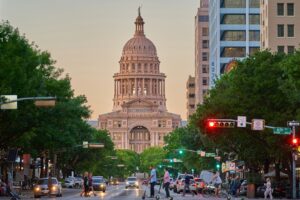
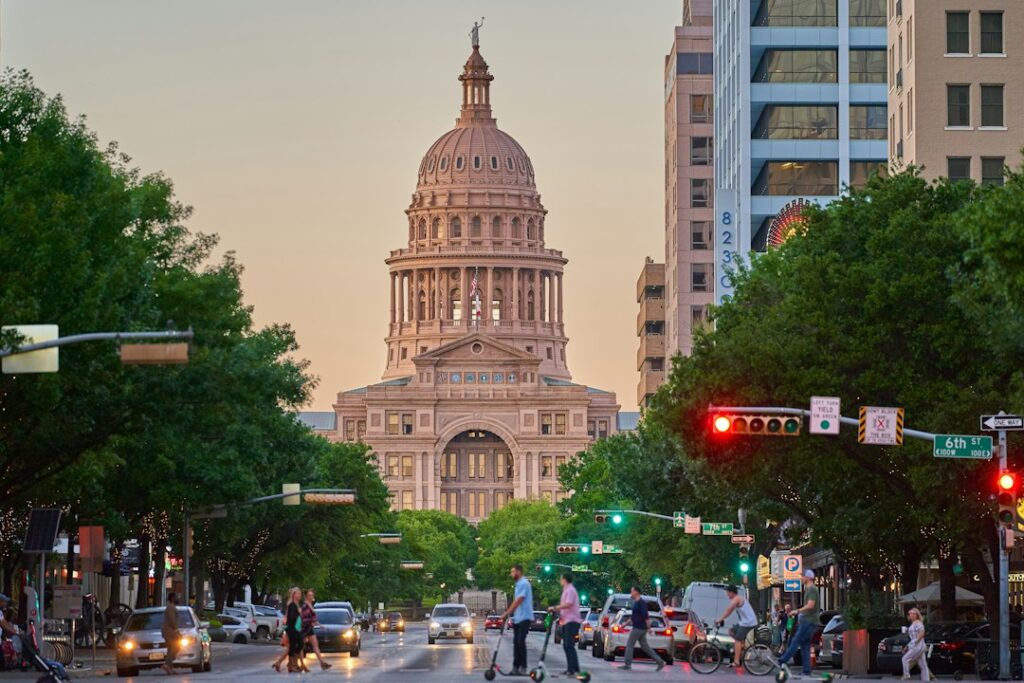
Photo: Texas State Capitol, Austin, archival location photograph by Justin Wallace via Unsplash. The photograph does not depict election-night events.