Democrats have won control of both chambers of the Wisconsin Legislature in the 2026 United States midterm elections, ending years of divided legislative power in a state where the balance of government has frequently been contested. Unofficial results give the party an 18 to 15 majority in the Senate and a 53 to 46 majority in the Assembly.
The outcome, reported on 4 November by Wisconsin Public Radio, gives Democrats control of both legislative chambers for the first time in 18 years. It forms part of a wider election in which Democrats won control of the US House of Representatives and Senate and gained ground in several state governments.
The Wisconsin result is a state legislative change, distinct from the national congressional contests. State lawmakers decide on matters including public spending, education, taxation and elements of election administration. Their decisions can affect residents directly, even when national politics attracts more attention.
According to the Associated Press, Democrats secured or retained unified control of state government in Wisconsin, Michigan, Minnesota, Pennsylvania and Nevada. The party also gained governorships in Georgia, Iowa, Ohio and Texas. Those developments represent separate state-level results and should not be confused with changes in the composition of Congress.
The AP reported that Democrats took control of the Texas House for the first time since 2002 and broke or prevented Republican supermajorities in nine legislative chambers across eight states. The changes may alter negotiations over budgets, voting rules and future electoral maps, although any particular legislative proposal will still require the applicable state procedures.
In Wisconsin, the new legislative arithmetic is particularly important because control of a chamber determines committee leadership, the handling of bills and the timetable for votes. A majority does not automatically mean that every proposal will become law. The governor’s position, constitutional requirements and disagreements within a party can all shape what happens next.
Election-night and post-election figures are not the same as certified final results. The Wisconsin chamber totals cited here are unofficial results, and the appropriate election authorities retain responsibility for canvassing and certification. A projected or reported majority should therefore be described accurately until the formal process is complete.
Across the country, voters’ concerns about housing costs, healthcare, education and energy bills featured prominently in the contest, according to the AP. Incoming lawmakers will face pressure to translate their electoral victories into decisions on these everyday issues. Some incoming governors have also spoken about working with political opponents.
The outcome has implications for immigrant and diaspora communities, including Nigerians and other Africans living in the United States. State governments influence schools, professional licensing, housing regulation and other services used by residents. However, the results alone do not establish that any particular immigration, education or business policy has changed.
The next stage will be the certification of results, the organisation of new legislative leadership and the introduction of policy proposals when the newly elected lawmakers take office. Wisconsin’s result is one of the clearest examples of how the 2026 midterms have changed political power beyond Washington.
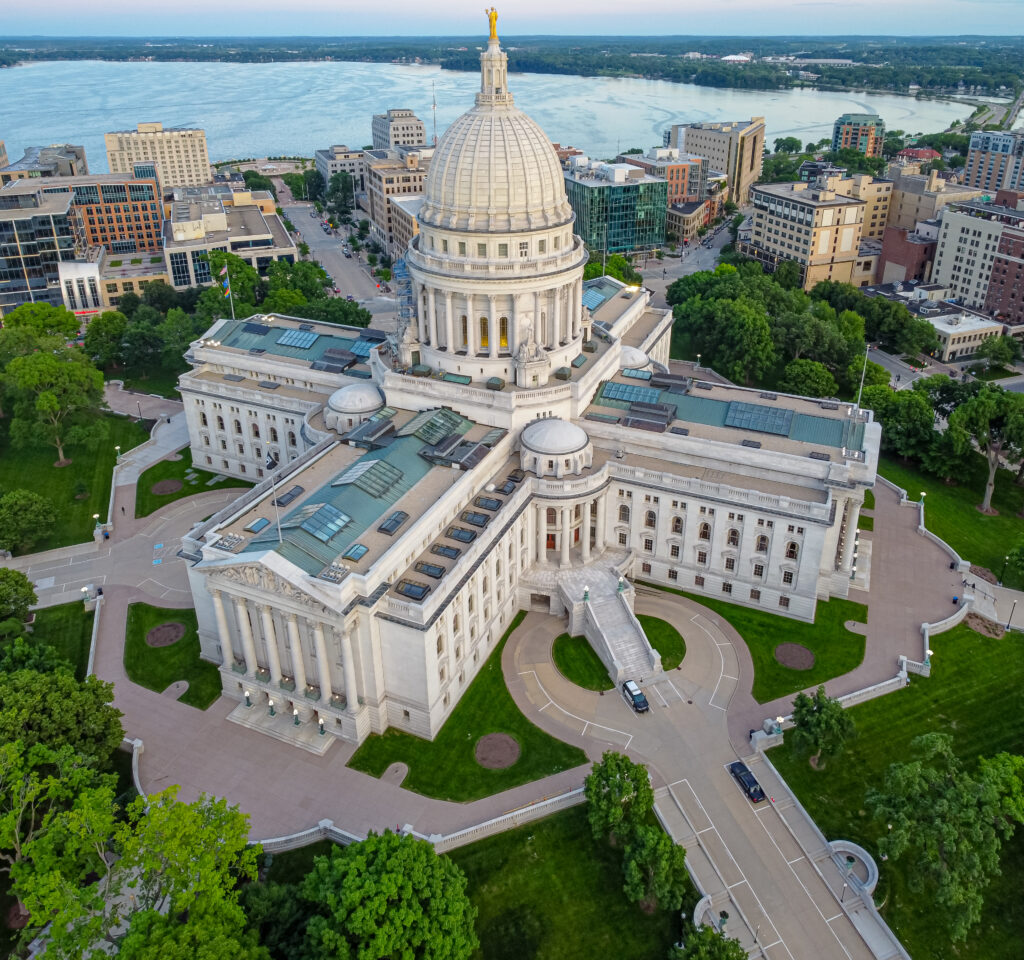
Image: Wisconsin State Capitol, photographed in 2024 by Wikideas1, Wikimedia Commons, CC0 1.0. Archival photograph; not an image of election-night proceedings.