Nigeria has ordered a no-fly restriction for at least 21 days for 46 Ebola contacts, following the confirmation of an imported infection in Abuja. Aviation Minister Festus Keyamo directed the civil aviation regulator to notify domestic and international airlines.
The directive followed a virtual meeting with Coordinating Minister of Health and Social Welfare Muhammad Ali Pate on Wednesday, 21 October. Keyamo set out the measures in a statement reported by Punch on 22 October.
He said Pate supplied the details of 44 people who encountered the affected woman at a hospital after she developed symptoms. Two members of her domestic staff were also included in the list.
Keyamo said officials were working to isolate the contacts while their infection status was established. “I have therefore directed the NCAA to immediately inform all local and international airlines of this development,” he said.
The minister also instructed the Federal Airports Authority of Nigeria to strengthen airport surveillance. Measures he described included temperature checks, health screening, travel-history monitoring, digital health declarations and coordination with the Nigeria Centre for Disease Control and Prevention.
The announcement sets out instructions to aviation authorities and airlines. It does not establish that all 46 people have tested positive. The minister’s description concerns identified contacts whose health status authorities are seeking to determine.
The World Health Organisation confirmed on 20 October that Nigeria had detected one imported case of Bundibugyo virus disease. The patient had recently travelled from Uganda, with symptoms beginning on 7 October, four days after her arrival in Nigeria.
She sought care at a private health facility in Abuja on 11 October, and laboratory confirmation followed on 20 October. WHO said she was in isolation and receiving medical care. Investigators were reconstructing her travel and exposure history to establish the likely source of infection.
WHO’s initial account, citing the health ministry, identified 44 contacts under monitoring. Keyamo’s later statement listed 44 hospital contacts and the additional two domestic staff, bringing the number covered by his aviation directive to 46.
The NCDC activated its incident management system to coordinate the response. WHO and its partners are supporting case investigation, contact tracing, infection prevention and the supply of protective equipment for health workers. WHO also urged laboratories and rapid-response teams to remain ready for suspected infections.
The agency’s 20 October statement advised against restrictions on travel to, or trade with, affected countries. That country-level travel advice is separate from the Nigerian minister’s targeted directive concerning the people identified as contacts.
WHO says Ebola’s incubation period, between infection and the start of symptoms, ranges from two to 21 days. People do not transmit the disease before symptoms appear. Transmission occurs through direct contact with infected blood or other bodily fluids, or materials contaminated by those fluids.
Early symptoms can include fever, fatigue, muscle pain, headache and sore throat. They can resemble other illnesses, making exposure history and laboratory testing important. WHO identifies monitoring contacts for 21 days, infection prevention and prompt care for confirmed patients among the measures used to contain outbreaks.
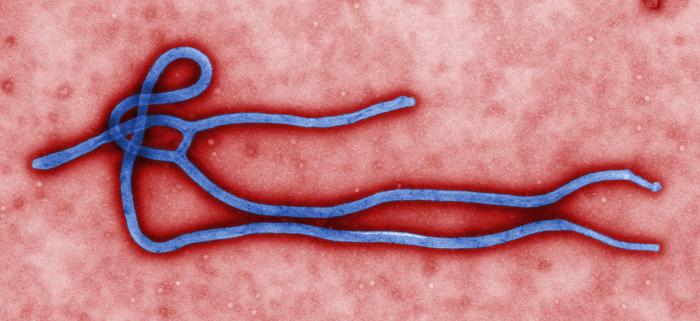
Scientific illustration: CDC/Cynthia Goldsmith. CDC Public Health Image Library image 10816, public domain and available from CDC as a free source. Digitally colourised electron micrograph of an Ebola virus particle, not a sample from the Abuja case and not identified here as Bundibugyo virus. Display versions may be resized or cropped.