Ayò Ọlọ́pọ́n brings two players together around twelve hollows. Moving the seeds becomes a contest of counting and anticipation. Spectators have their own greetings, while carved boards preserve a history of artistic skill and social standing.
For curator and writer Jareh Das, its associations begin with childhood holidays. Writing for Yinka Ilori’s studio, she recalled encountering the game in Ibadan, where her mother worked, or at her uncle’s home in Warri. She could not remember which came first, but both cities remained linked to those memories beyond her Lagos upbringing.
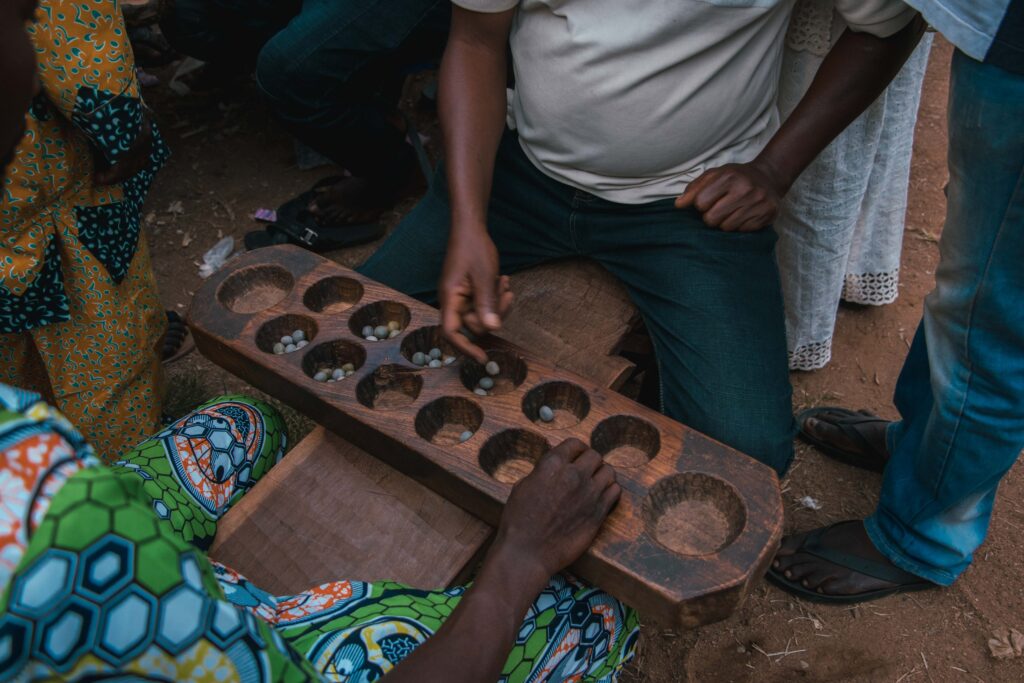
The familiar arrangement has two rows of six holes, with four seeds placed in each at the start. Each player controls a row. Players take seeds from a hollow and distribute them around the board, working towards captures rather than moving individually ranked pieces such as those found in chess.
The Smithsonian’s National Museum of African Art places ayoayo within the wider mancala family of count-and-capture games. Its account emphasises strategy rather than luck. The family extends across several continents, with different local names, board arrangements and methods of play.
That variety matters when discussing the rules. Das describes a capture involving four seeds, while the Open University’s teaching resource sets out an Oware version involving captures of two or three. A shared board layout therefore does not make every named version identical.
The Open University includes the game in its TESSA Nigeria material on investigating number and pattern. Its classroom instructions ask players to count stones, distribute them anticlockwise and compare their final captures. The resource gives teachers a practical activity within a numeracy module, rather than reporting a measured improvement in children’s attainment.
Carvers have also transformed the playing surface into a sculptural object. An early to mid-twentieth-century wooden board in the National Museum of African Art’s collection, numbered 93-2-1, has ten supporting male figures. A male and female couple decorates one end; paired snakes occupy the other.
The museum identifies the maker as a Yoruba artist. It explains that finely worked boards could signal elevated political or social status and serve as prestigious gifts. Alongside such examples, its account records simpler playing surfaces made by hollowing the earth or exposed roots.
Conversation accompanies the counting. Yorubas in Pirkanmaa, a community association in Finland, records a greeting addressed to people playing Ayò: “Mo ki ọ̀ta, mo ki òpè”. Its explanation translates this as a greeting to both the winning and losing sides, recognising the contest without addressing only the person ahead.
The association’s account, first published in July 2024, describes the same twelve-hole arrangement and forty-eight seeds. It presents the game as a form of social interaction and entertainment within Yoruba communal life, carrying its vocabulary into a diaspora setting.
Women’s competitive play also appears in the record published by Ilori’s studio. An accompanying photograph identifies Ronke Lawal of Abeokuta South and runner-up Sadiat Sokunbi of Ifo in the women’s final at the 2016 Lisabi Festival. The match took place at the Ake Palace grounds on 1 March 2016.
Archive photograph: Thorlannie, Playing Ayo, Nigeria, 2 November 2018. Wikimedia Commons, CC BY-SA 4.0. The players are not identified as the people discussed in this feature. Website image resized; landscape and social versions cropped and resized under the same licence. Image source; licence.