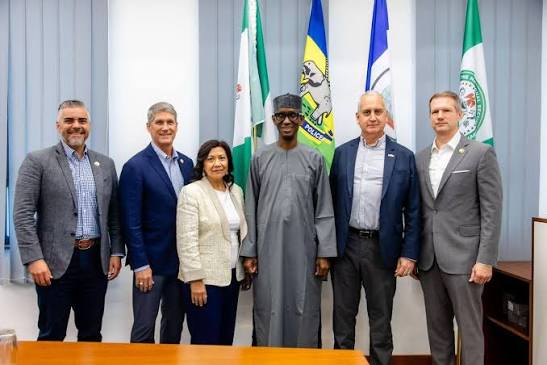
A United States congressional delegation engaged in a fact-finding mission to Nigeria held a closed-door meeting with the country’s Attorney-General of the Federation and Minister of Justice, Lateef Fagbemi. The discussion focused squarely on the Nigerian government’s efforts and judicial process in prosecuting individuals arrested for terrorism and extremist activities.
This high-level meeting represents a direct diplomatic engagement on issues of security and justice that have drawn intense international scrutiny.
The delegation, which included US Congressman Riley Moore and the US Ambassador to Nigeria, Richard Mills Jr., sought to understand the Federal Government’s perspective on combating terrorism. The meeting was part of a broader itinerary for the US team, which has previously met with the National Security Adviser, Nuhu Ribadu, and traveled to Benue State to engage with state officials, religious leaders, and traditional rulers.
The visit stems from elevated international concern, notably after US President Donald Trump declared Nigeria a “country of particular concern” last October, citing allegations of mass violence against Christians.
Speaking to journalists after the meeting, Attorney-General Fagbemi emphasized that the purpose was to explain Nigeria’s position and actions regarding its security challenges.
He stated that the dialogue provided an opportunity to detail the government’s side of the story, following earlier explanations given during a visit to Washington. Fagbemi was keen to stress a central point of the Nigerian government’s narrative: that the pervasive violence and killings within the country are not fundamentally religious conflicts.
He asserted that Nigeria faces serious security challenges and that the government is doing its utmost to address them, but these challenges are not driven by religion.
On the specific matter of prosecutions, Fagbemi provided concrete figures to demonstrate the judiciary’s activity. He disclosed that from 2017 to the present day, the government has secured a total of 860 convictions in terrorism-related cases. In a pointed illustration of the judicial process at work, he also noted that 891 individuals had been discharged or acquitted in the same period.
He presented these acquittals not as failures but as evidence of the rule of law, explaining that suspects are profiled and that only those against whom a case can be built are prosecuted, with the courts having the final say.
Fagbemi elaborated that this balance of convictions and acquittals speaks to the government’s commitment to due process. He explained that the system does not arbitrarily detain people but follows legal procedures, and the government abides by court decisions whether they result in conviction or release.
The Attorney-General also revealed that the visiting US Congressman had conducted meetings with a wide array of entities beyond the justice ministry, including other security agencies, the military leadership, and civil society and religious organizations, aiming to gather a comprehensive view of the situation.
In his concluding remarks, Fagbemi appealed for perspective on Nigeria’s circumstances. He urged the public and international observers not to exaggerate or misrepresent the severity of the situation, assuring them that while real problems exist, the portrayal is often more heinous than the reality.
He reiterated his stance that the core of Nigeria’s trials is rooted in security issues, not religious war, as his ministry and the broader government continue their work within the legal framework to prosecute those involved in extremist violence.