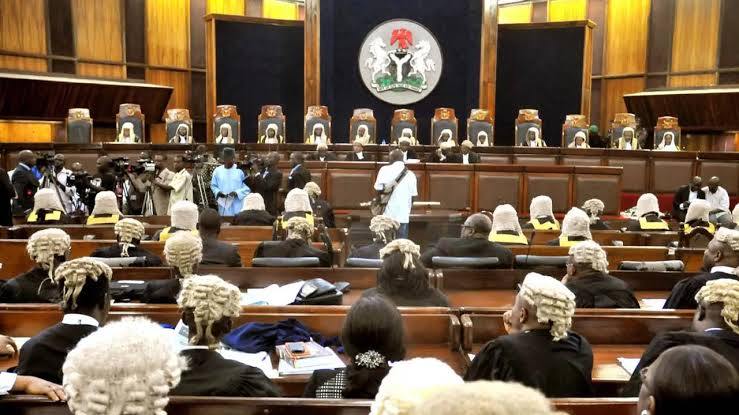
In a landmark ruling with profound implications for Nigeria’s constitutional balance of power, the Supreme Court has affirmed that the President has the authority to suspend elected state officials during a state of emergency.
The apex court delivered a split decision of six-to-one, settling a major legal dispute stemming from the political crisis in Rivers State.
The case was brought before the court by Adamawa State and ten other states governed by the Peoples Democratic Party.
They challenged the legality of the state of emergency declared by President Bola Tinubu in Rivers State in 2023, during which Governor Siminalayi Fubara and other elected officials were suspended from office for six months.
In the lead majority judgment, Justice Mohammed Idris held that Section 305 of the Nigerian Constitution empowers the President to deploy “extraordinary measures” to restore normalcy when an emergency is declared.
The court found that the Constitution grants the President discretion in determining what those measures entail, which can include suspending elected officials. However, the judgment emphasized that such a suspension must be for a limited period and cannot be indefinite.
Crucially, before ruling on the substantive issue, the Supreme Court first upheld preliminary objections from the defendants—the Attorney General of the Federation and the National Assembly.
Justice Idris stated that the 11 plaintiff states failed to establish a proper “cause of action” to invoke the court’s original jurisdiction. Therefore, the suit was struck out for want of jurisdiction.
Despite this, the court proceeded to also dismiss the case on its merits, providing a definitive interpretation of the law.
Justice Obande Ogbuinya delivered the sole dissenting opinion. He argued that while the President has the power to declare a state of emergency, this power should not extend to the suspension of democratically elected officials like governors and lawmakers.
This ruling provides significant constitutional clarity, reinforcing the extensive powers available to the executive during a declared emergency, while also establishing an important judicial check by requiring that any suspension of elected officials be temporary.