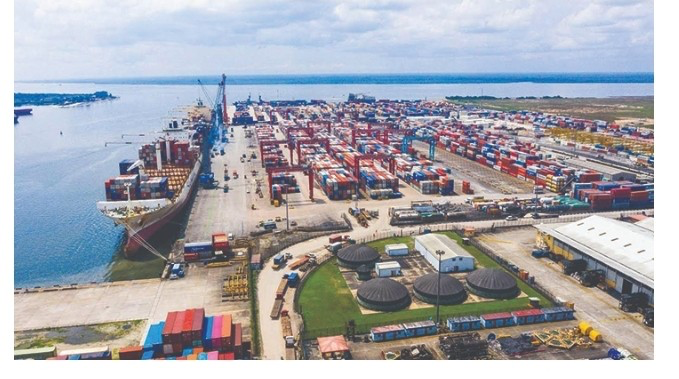
A national debate over the future of Nigeria’s ports has been reignited following comments by Lagos State Governor Babajide Sanwo-Olu, which have been interpreted as expressing concern over federal plans to revive ports outside of Lagos.
The controversy centers on the tension between maintaining Lagos’s long-held dominance as the nation’s primary maritime gateway and the push to create a more efficient and distributed port system to aid the broader Nigerian economy.
For decades, the Apapa and Tin Can Island ports in Lagos have handled an overwhelming majority of the country’s imports, estimated at between 70 and 80 percent.
This concentration has cemented Lagos’s role as Nigeria’s commercial nerve center but has also created severe structural problems, including legendary traffic congestion, dilapidated port access roads, and some of the highest logistics costs in Africa. This situation is described in the debate as a “structural liability” for the nation.
In response to these chronic inefficiencies, the federal government has intensified efforts to reactivate and modernize other major ports, specifically those in Warri, Onne, and Calabar.
The goal is to reduce the crippling pressure on Lagos, lower national logistics expenses, and stimulate economic development in other regions.
The Managing Director of the Nigerian Ports Authority has emphasized that Nigeria cannot afford to continue with a “single-city port model.”
The League of Maritime Editors publicly criticized Governor Sanwo-Olu, interpreting his remarks as an attempt to preserve Lagos’s economic dominance at the expense of national progress.
The group argued that reviving other ports is an essential step for creating a competitive maritime system and that Nigeria’s vast logistics chain can no longer rely solely on one congested state.
Officials from Lagos State counter that their position is not one of simple resistance but is based on practical economic concerns.
They argue that a sudden diversion of cargo away from Lagos, without massive parallel investments in nationwide infrastructure like secure waterways, dredged channels, and connecting rail links, could severely disrupt the dense cluster of industries and complex supply chains based in the state. Their fear is that this could destabilize vital revenue streams.
The article suggests the core issue is less a political clash and more a critical question of sequencing and strategy.
Policymakers are grappling with whether to first invest heavily in upgrading alternative ports before shifting cargo, to further modernize Lagos to handle current volumes, or to pursue both goals simultaneously under a coordinated national plan.
Amid this debate, it is noted that Lagos has undertaken its own reforms, such as the implementation of the Ètò electronic call-up system for port trucks, which has processed millions of journeys and reportedly reduced haulage costs.
However, industry stakeholders also point out that persistent problems like extortion and administrative bottlenecks continue to hamper efficiency.
The article concludes that Nigeria’s maritime system is at a decisive crossroads. The optimal path forward is framed not as a choice between Lagos and other ports, but as an opportunity to build an integrated, multi-port network.
This would involve leveraging the established strengths of Lagos while strategically developing the potential of ports in Warri, Onne, and Calabar through coordinated national planning and significant investment in connecting infrastructure.