The United States has imposed sanctions on Rwanda’s Ministry of Defence and Zigama Credit and Savings Society, accusing them of supporting armed rebels in eastern Democratic Republic of Congo. The measures announced on Wednesday, 28 October, extend earlier action against Rwanda’s military.
The US Treasury’s Office of Foreign Assets Control said the ministry supported the Rwanda Defence Force, which Washington sanctioned on 2 March. It designated Zigama over alleged support for the military, the March 23 Movement, known as M23, and the Congo River Alliance.
Treasury accused Zigama of facilitating payments for military equipment and training, as well as financial transactions for the rebel organisations. It also alleged that a branch helped move gold from rebel-controlled Congolese territory to Kigali.
The designations block the targets’ property within US jurisdiction. They generally prohibit transactions involving that property by US persons or through the United States, unless authorised or exempt. Entities owned at least 50 per cent by blocked persons are also covered.
Rwanda denies backing the rebels. Government spokesperson Yolande Makolo said commitments to neutralise the Democratic Forces for the Liberation of Rwanda, or FDLR, remained unmet. She said Rwanda remained willing to implement the Washington Accords alongside reciprocal action by Congo, Reuters reported.
Congo’s foreign ministry welcomed the sanctions and called for Rwanda to withdraw its troops, according to the agency’s account of its statement.
In a separate announcement, US State Department spokesman Tommy Pigott accused Rwandan troops of fighting alongside M23 in North and South Kivu. He said the forces had supplied weapons and training and brought surface-to-air missiles and jamming equipment into the conflict, creating dangers for civilian aviation.
The State Department said that support violated the Washington Accords for Peace and Prosperity, signed by the two countries’ leaders on 4 December 2025. The agreement envisaged ending the conflict while expanding trade and investment across Africa’s Great Lakes region.
Washington also linked its latest action to conditions in rebel-controlled mining areas. Pigott said civilians working in gold and coltan zones faced forced labour, dangerous conditions and illegal taxation. He urged international partners and private businesses to examine their supply chains.
The new designations target the defence ministry and the financial institution, separately from the March sanctions against the Rwanda Defence Force and four senior military officials. They do not establish that the conflict has ended or that the parties have implemented their peace commitments.
Fighting continues to displace civilians and restrict relief work. At its 15 October briefing, the United Nations said recent hostilities in North and South Kivu had forced more than 26,000 people from their homes.
The UN also warned that insecurity was disrupting humanitarian access in Ituri province. It said the deteriorating security situation was affecting the Ebola response, adding another obstacle for communities already confronting violence and displacement.
Wednesday’s action follows months of diplomatic efforts to enforce the peace agreement. The State Department called for an end to support for M23 and successor armed groups, alongside the withdrawal of Rwandan forces from eastern Congo.
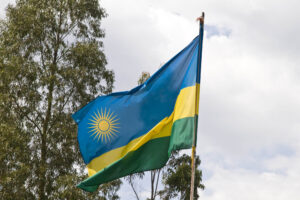
Archive illustration: Rwandan flag, 24 February 2008, by Hjalmar Gislason / Wikimedia Commons, CC BY 2.0. Source photograph, not the sanctions announcement. Source | Licence.