The Federal Government and the Nigeria Labour Congress have agreed on ₦70,000 transport support for workers over six months from November 2026. The measure forms part of a welfare agreement reached at a conciliation meeting in Abuja on Tuesday, 27 October.
The agreement also provides for payment of outstanding allowances and immediate commencement of minimum-wage negotiations. However, the parties did not agree on the effective date for implementing a new minimum wage, leaving a central issue in the talks unresolved.
Labour Minister Muhammad Maigari Dingyadi chaired the meeting, while NLC President Joe Ajaero led the union delegation. It followed an earlier session on 22 October convened to address workers’ demands over living costs, petrol prices, pay and outstanding allowances.
In a ministry statement reproduced by Channels Television, the government said the transport intervention would apply “across all levels” for six months. The published wording does not explicitly describe the ₦70,000 as a monthly payment, although several reports have presented it that way.
Tribune reported that the payment terms, including whether the amount was payable monthly to each eligible worker, required clarification. Payment dates and detailed administrative arrangements were not set out in the published resolutions.
The government also agreed to pay arrears of the peculiar allowance approved with effect from 1 May 2026. Those outstanding amounts are scheduled for payment in three equal monthly instalments beginning in November.
For health workers, the agreement provides for the redemption of 19 months of outstanding allowances within three months from December 2026. That commitment is separate from the proposed adjustment to the Consolidated Health Salary Structure, known as CONHESS.
The National Salaries, Incomes and Wages Commission is to update its assessment of the cost of the CONHESS adjustment within three weeks. The assessment will enable the Presidential Committee on Salaries to consider the proposal; it is not a final approval of the adjustment.
Hazard allowances for agricultural officers remain at the verification stage. The Ministry of Agriculture and Food Security has submitted the proposed beneficiaries and cost implications to the wages commission. Verification is expected within two weeks, followed by an implementation template.
Tax relief was also discussed but remained subject to further consideration. The resolutions therefore combine payment commitments with proposals still awaiting negotiations, cost assessments or administrative decisions.
The government and labour representatives urged state and local governments to participate. Unions were encouraged to press for implementation at their respective levels. The resolutions did not announce specific state or local-government payment schedules.
The talks followed sustained pressure from organised labour over household costs and unresolved welfare agreements. Earlier in October, the NLC demanded action on petrol prices, wages and other benefits, warning of possible industrial action if its concerns were not addressed.
The agreement was signed by Dingyadi, Ajaero, Budget Office Director-General Tanimu Yakubu and Garba Abdul of the federal civil service’s Service Welfare Office. Gbenga Olowoyo signed for the Joint National Public Service Negotiating Council, according to the communiqué reported by the Nigeria Union of Journalists’ FCT council.
Both sides agreed to reconvene after one month to assess implementation of the commitments.
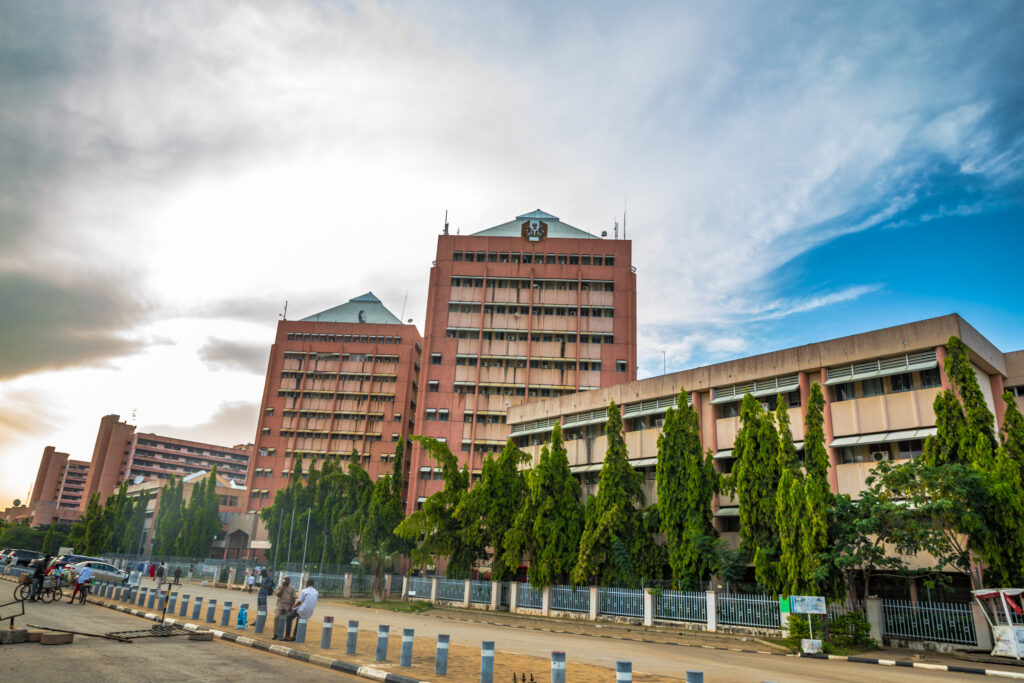
Archive photograph: Federal Secretariat Complex, Abuja, 31 October 2018. Ovinuchi Prince Ejiohuo / Wikimedia Commons, CC BY-SA 4.0. Resized; not the October 2026 labour meeting.