President Bola Tinubu has reaffirmed his refinery revival plan, proposing technical assessments, stronger partnerships and tighter operational discipline. He set out the approach at the opening of OTL Africa Downstream Energy Week in Lagos on Monday, 26 October.
Tinubu was represented by Patience Oyekunle, Permanent Secretary of the Federal Ministry of Petroleum Resources. His address linked the future of public refining assets to a wider ambition to process more Nigerian crude domestically and supply petroleum products to African markets.
The President said the government wanted to avoid leaving existing national refining assets stranded as private refining capacity expanded. The facilities include the Port Harcourt, Warri and Kaduna refineries, operated by the Nigerian National Petroleum Company Limited.
“Nigeria must refine more of its crude, create more value domestically and become a reliable supplier of energy to Africa,” he said.
The address set out an intended rehabilitation strategy, rather than announcing that the refineries had resumed operations. The reported address did not include a reopening timetable for the public refineries.
NNPC’s proposed partnership for Port Harcourt and Warri remains an important part of that process. The company announced in May that it had signed a memorandum of understanding with Sanjiang Chemical Company Limited and Xinganchen (Fuzhou) Industrial Park Operation and Management Company Limited.
The agreement was signed in Jiaxing, China, on 30 April. NNPC described it as a potential technical equity partnership covering outstanding work, operation and maintenance at the two refineries. Possible expansion into petrochemicals and nearby gas-based industrial hubs was also contemplated.
The company’s announcement distinguished the memorandum from definitive arrangements. It said further agreements would depend on continued discussions and the necessary approvals. Kaduna was not included in the two-refinery framework described in that release.
On 14 October, NNPC spokesman Andy Odeh told The PUNCH that technical reports from the Chinese partners were being finalised after on-site assessments. The company said it wanted partners that would invest and share responsibility for performance, rather than contractors whose involvement ended after payment for work.
At Monday’s forum, Tinubu also identified gas development as a central part of the administration’s industrial plans. He cited production targets of 10 billion standard cubic feet daily by 2027 and 12 billion by 2030 under the Gas Master Plan 2026. These are targets, rather than achieved production levels.
He said greater gas use could support electricity generation, manufacturing, compressed natural gas, cooking gas and petrochemical production. The address also urged closer cooperation between crude producers and refiners to improve domestic feedstock supply.
Lagos State Governor Babajide Sanwo-Olu told the forum that energy costs continued to put pressure on households and businesses. He said reliable supply and affordable prices, rather than refinery output alone, should determine the sector’s success.
Sanwo-Olu linked expensive or unreliable energy to higher transport fares, factory costs and the cost of getting food to markets. He said the effects reached commuters, traders and small businesses as well as petroleum companies.
The event marked the twentieth anniversary of OTL Africa Downstream Energy Week and was held under the theme Secure Energy, Shared Prosperity.
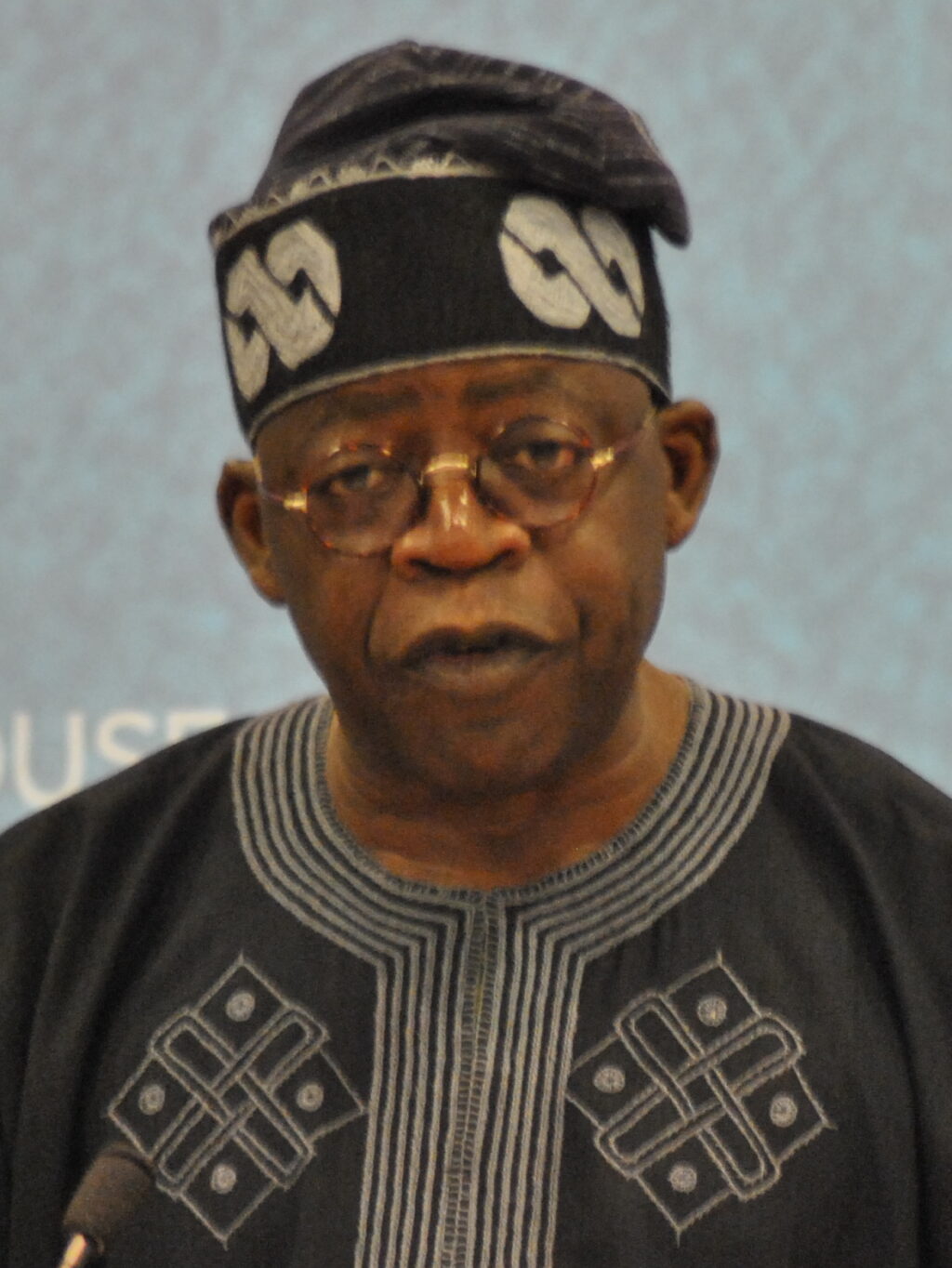
Image: Bola Tinubu at Chatham House, 18 July 2011. Chatham House, Wikimedia Commons, CC BY 2.0. Cropped archive portrait; does not show the 2026 energy forum.