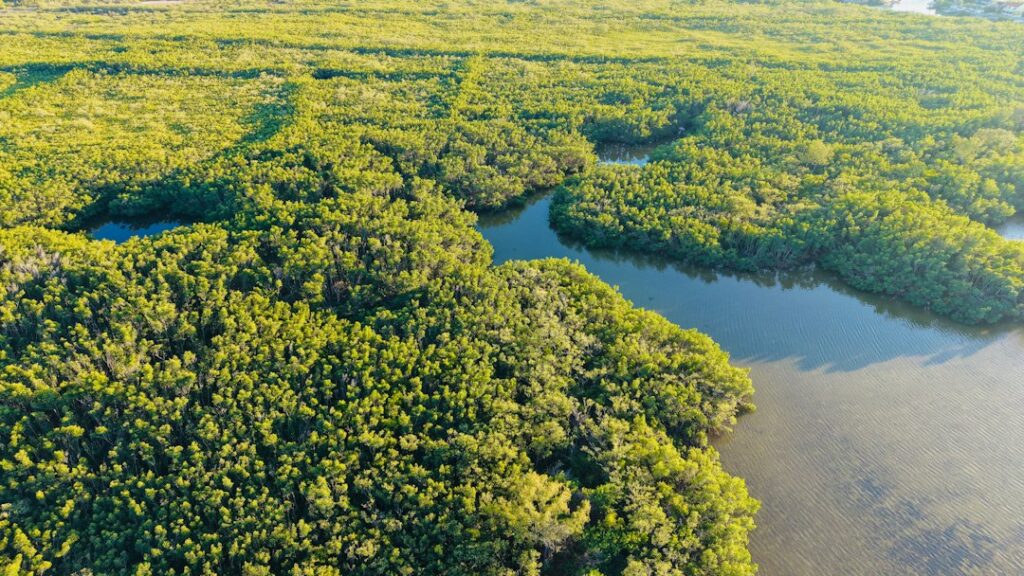
A women-led restoration initiative in Nigeria’s Niger Delta has planted three million mangrove saplings and reclaimed about 190 hectares of degraded swamp forest, offering a striking example of how environmental repair can also rebuild livelihoods and local authority.
The work is being led by the Lokiaka Community Development Centre, founded by Ogoni environmental advocate Martha Agbani. Since 2018, its teams have trained women from oil-producing communities to restore native mangroves in wetlands damaged by decades of pollution, invasive plants and the disruption of fishing and shellfish harvesting.
Agbani established the centre in 2003 to support women farmers and connect environmental recovery with social and economic renewal. More than 400 women from different communities have now received practical training, according to figures shared by the organisation, with many passing the skills to others in their own settlements.
The scale of the effort has become clearer through recent reporting from Ogoniland. At Teenama, a wetland between the Kwawa and Kpean oil settlements in the Yorla oilfields, community teams have planted more than 150,000 saplings. Women work in the mud with simple two-metre spacing sticks, using lessons from earlier planting rounds to avoid crowding young trees too closely.
That detail matters. Mangrove recovery cannot be measured only by the number of seedlings put into the ground. Survival depends on tides, salinity, water movement, soil conditions, the removal of invasive species and long-term community care. Poorly chosen sites can turn an impressive planting target into a field of dead saplings.
Environmental scientist Erabanabari Kobah has stressed that restoration must be judged by what happens to a forest over time. The warning is especially relevant in a region where ecological projects can be announced with large figures but little public evidence about survival rates, biodiversity or the return of local livelihoods.
In Teenama, the project’s signs of progress include the return of fish and crabs. Agbani described the change in a simple phrase: “Life is returning.” For families who once relied on mangrove-lined creeks for food and income, that recovery is not an abstract climate benefit. It can mean renewed access to fisheries, shellfish and other resources that support household survival.
Repairing an ecosystem and a local economy
Mangroves are among the Niger Delta’s most valuable natural defences. They provide nurseries for fish, shrimps and molluscs, protect shorelines, store carbon and sustain communities built around coastal waters. Nigeria contains one of the world’s largest mangrove areas, making the fate of the Niger Delta important far beyond the communities directly affected.
Yet the forests have absorbed the effects of oil production and repeated spills for decades. In Bodo, two major spills in 2008 and 2009 destroyed large areas of mangrove habitat and led to a compensation settlement for local residents. Ferdinand Giadom of the Bodo Mediation Initiative estimates that about 1,000 hectares of mangroves were directly destroyed by the 2008 spill alone.
The damage has also created room for nipa palm, an invasive species that spreads aggressively through disturbed wetlands. Dense nipa stands crowd out native mangroves and can obstruct community access to waterways. Around Teenama, men clear affected areas before trained women plant native saplings, turning restoration into a shared community effort.
The federal Hydrocarbon Pollution Remediation Project has separately described the wider Ogoni cleanup as a climate action programme and has called for the expansion of mangrove restoration. Its work provides a national framework, but the Lokiaka model highlights why local ownership remains essential. Residents know where water moves, where native species once thrived and how changes in the forest affect daily work.
Women move from the margins to the centre
The project’s most important contribution may be who holds that knowledge and makes decisions. Women often depend heavily on forests and waterways for food processing, farming, fishing-related work and family income, yet they are frequently excluded from formal discussions about cleanup contracts and land management.
Lokiaka’s approach puts them at the centre. Training takes place in the swamp rather than only in classrooms, with experienced restorers guiding participants through site selection, spacing, species identification and the handling of mangrove buds. The centre also works with local fishers, linking forest recovery to the health of the wider aquatic ecosystem.
Joy Lebewi, one of the trained planters working at Teenama, captured the sense of responsibility behind the effort when she said: “This is our forest.” The statement is significant in Ogoniland, where many residents believe decades of extraction stripped communities not only of healthy land and water but also of control over decisions affecting their future.
Agbani’s commitment is rooted in that history. Her mother, Theresa Terabiewaa Agbani, was an activist, and the 1995 execution of writer and environmental campaigner Ken Saro-Wiwa and eight other Ogoni activists shaped her understanding of the region’s struggle. Her chosen form of activism has been restoration, organised around the patient work of rebuilding wetlands and the livelihoods attached to them.
The achievement should still be assessed carefully. Independent monitoring of sapling survival, water quality, species recovery and household income would help show how much of the reclaimed area is becoming a functioning forest. Long-term protection is also necessary to prevent fresh pollution or poorly planned development from undoing years of work.
Even with those cautions, the project offers a practical lesson for environmental policy in Nigeria. Restoration is strongest when it combines science, local knowledge, livelihood recovery and public accountability. Planting trees is only the beginning. The real goal is a living wetland that communities can protect and depend upon.
Residents, researchers and public agencies should continue tracking the restored sites and reporting measurable results. Readers with verified information about similar community-led environmental projects in Nigeria can share their stories with Podium News for possible coverage.