
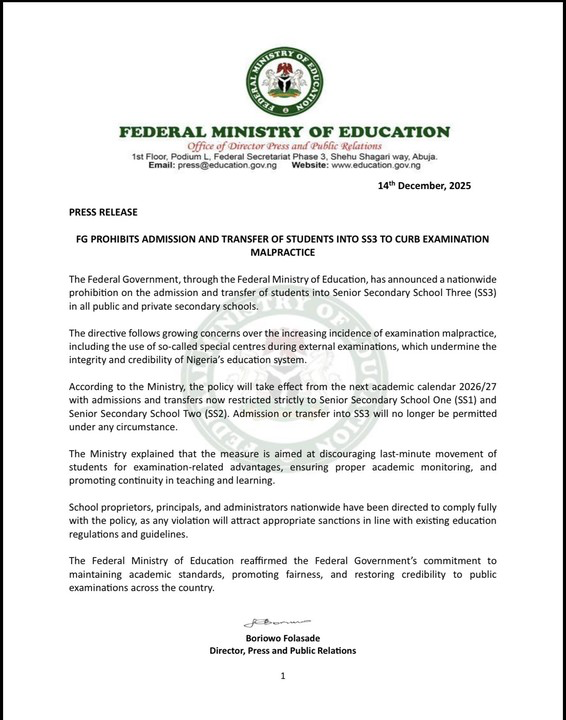
The Federal Government of Nigeria has announced a sweeping nationwide ban on the admission and transfer of students into Senior Secondary School Three (SS3) in all public and private schools.
This new policy, set to take effect from the 2026/27 academic session, was announced by the Federal Ministry of Education as part of a major effort to curb rampant examination malpractice and restore credibility to the country’s education system.
According to an official statement signed by the Director of Press and Public Relations, Boriowo Folasade, the directive is a direct response to growing concerns over increasing incidents of malpractice. These include the notorious use of “special centres” where students are illicitly moved just before external examinations to gain unfair advantages.
The ministry explained that the policy aims to ensure proper academic monitoring and promote continuity in teaching and learning by discouraging last-minute movements of students for examination-related gains.
Under the new rule, student admissions and transfers will now be strictly restricted to Senior Secondary School One (SS1) and Senior Secondary School Two (SS2). The ministry was emphatic, stating that “Admission or transfer into SS3 will no longer be permitted under any circumstance.”
This move is intended to lock students into a two-year academic track within a school, allowing for consistent teaching and assessment before they sit for their final exams.
School proprietors, principals, and administrators across the country have been directed to comply fully with the new policy. The ministry issued a stern warning that any violation would attract sanctions in line with existing education regulations and guidelines.
The government reaffirmed its commitment to maintaining academic standards and promoting fairness in public examinations.
This policy represents a significant structural change to Nigeria’s secondary education system. It seeks to address a deep-rooted problem that has long undermined the value of secondary school certificates.
By forcing students to complete their final two years in one institution, authorities hope to eliminate a key avenue for exam fraud and begin the process of restoring national and international confidence in Nigerian educational qualifications.