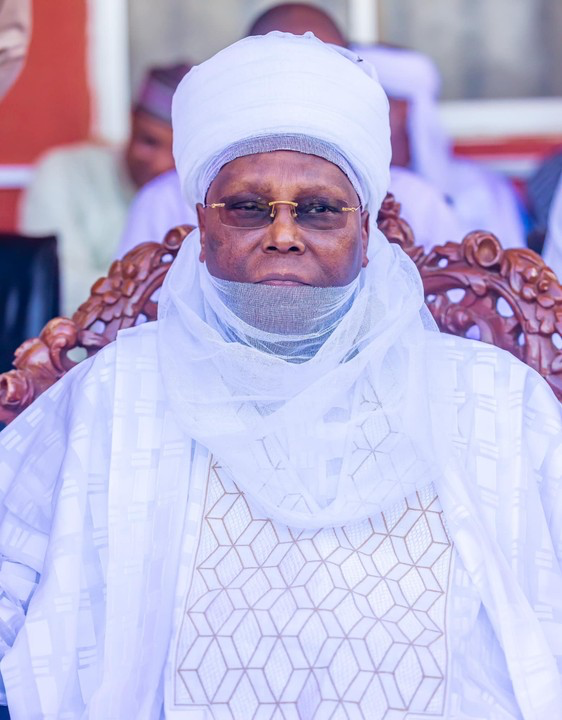
The Adamawa State Government has officially revoked the prestigious Waziri Adamawa title from former Vice President Atiku Abubakar, citing a new indigeneship policy that disqualifies non-indigenes from holding key positions within the emirate council. The Waziri Adamawa, traditionally the second highest-ranking figure after the Lamido of Adamawa, is a revered title that Atiku has held since 2017.
The decision, communicated in a circular dated June 20, 2025, and signed by Mrs. Adama Felicity Mamman, Permanent Secretary of the Department of Chieftaincy Affairs, also affects other prominent titleholders, including the Walin Adamawa. The new policy stipulates that only indigenes from specific districts—Yola South, Yola North, Girei, Mayo-Belwa, Song, and Zumo—are eligible for emirate council titles, effectively disqualifying Atiku, who hails from Jada Local Government Area under the Ganye Chiefdom.
While the government maintains that the move is part of a broader administrative restructuring following the creation of new chiefdoms, political analysts widely interpret it as a calculated effort to diminish Atiku’s influence in his home state. The action comes amid a deteriorating relationship between Atiku and Governor Ahmadu Umaru Fintiri, both of whom were key figures in the Peoples Democratic Party during the 2023 elections but have since become political rivals.
The directive has sparked outrage and speculation, with critics viewing it as a public humiliation and a potential precursor to broader changes in the state’s traditional institutions. A controversial bill currently before the Adamawa State House of Assembly seeks to further empower the governor to depose or appoint traditional rulers, raising concerns about increased political interference in royal affairs.
Atiku’s media office has condemned the move as politically motivated and indicated plans to challenge the decision through legal and traditional channels. The development marks a significant shift in Adamawa’s political and traditional landscape, with implications for both local governance and national politics.